Beginner’s guide · Make & create
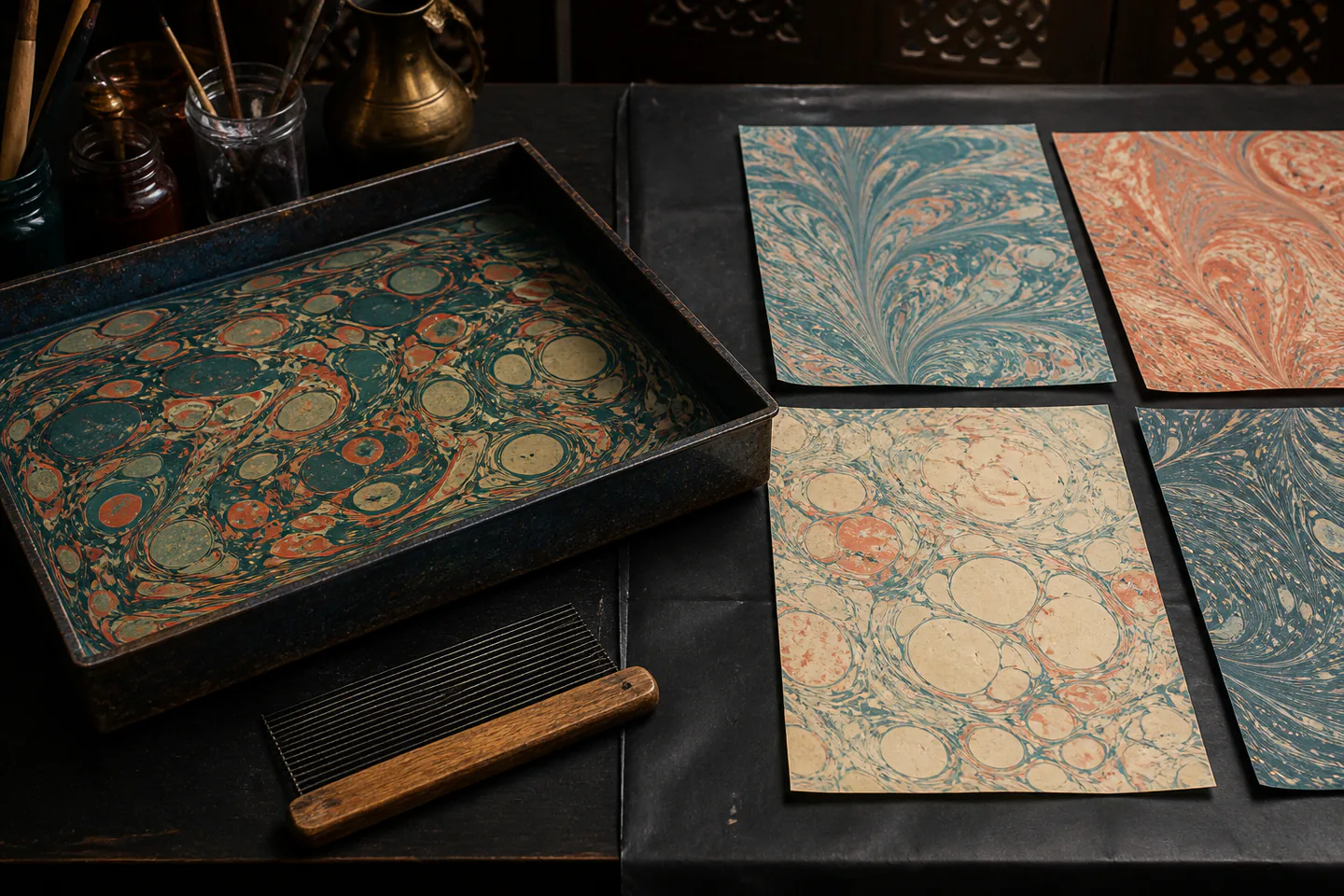
Four clean small sheets with stone and comb patterns
Test the bath before decorating the whole sheet.
Start with a matched marbling kit and small papers rather than assembling unfamiliar paint, size and mordant separately. Controlled drops, clean tools and repeatable notes make the floating pattern understandable.
Quick answer
Use one matched kit and perfect a small stone pattern first
Read the exact kit instructions from beginning to end because water-only and thickened-size systems are not interchangeable. Prepare the bath and any paper treatment exactly as specified, then test one colour drop at the centre. It should spread without vanishing or sinking. Add three or four rings, lower a small prepared sheet from one edge to the other, lift it cleanly and rinse only if the system requires it. Record bath age, paint dilution and paper so the next pull changes one factor.
- 01
Marbling systems vary: some float prepared paints on water, while traditional methods use thickened size and often treated paper. Follow one system at a time.
- 02
A matched kit reduces chemical guesswork but does not eliminate testing. Water hardness, temperature, paper sizing and contamination still affect spread.
- 03
The pattern transfers in seconds. Drying, flattening and documenting the recipe take longer than the decorative movement.
- 04
Use art materials only for their labelled purpose and keep marbling trays and utensils separate from food preparation.
What to expect
Cleanliness and chemistry are part of the pattern
Paint that sinks or races to the edge is usually reporting a compatibility, dilution or contamination problem—not a lack of artistic talent.
Bath
Prepare volume and thickener exactly and allow any required hydration or bubble settling before the first test.
Paint
Shake or stir as directed, use dedicated droppers and adjust only in small measured steps.
Paper
Paper sizing and mordant treatment change uptake; label the reverse in pencil before marbling.
Pattern
Stone circles teach spread. Combing should follow only after the surface holds several clean colours.
Transfer
Lay the sheet once without trapping large air pockets or sliding it sideways through the pattern.
Reset
Skim residue between pulls and clean tools without introducing detergent or another colour accidentally.
Core method
Control one bath, one paper and one pattern family
Choose a complete system
Use a current kit whose instructions specify bath, paints, paper preparation, rinsing and cleanup. Do not combine mordants, surfactants or thickener recipes from unrelated tutorials. Cover the table, level the shallow tray and prepare more small sheets than expected so tests are cheap.
Prepare and label methodically
Measure water and any size by the stated ratio, mix without whipping unnecessary bubbles and rest it for the stated time. Treat paper only if instructed, mark the back in pencil and lay it flat to dry. Put each colour in a dedicated dropper or brush.
Test spread before designing
Drop the lightest colour in the centre and watch its edge. Add another colour only if the first floats. If paint sinks, beads or clears the surface, consult the kit troubleshooting sequence and change one variable—dilution, bath, tool cleanliness or paper—rather than adding everything.
Pull, rinse and dry consistently
Build a simple stone pattern, lower the paper in a smooth arc and lift without dragging. Rinse or scrape the reverse only as instructed, then place the sheet on a protected flat or hanging drying system. Skim the bath, log the recipe and make the next pull with one deliberate change.
Useful products
Products with a clear job in the setup
House of Crafts offers the simplest compact route; the Jacquard starter kit is an alternative system with broader traditional components; the class pack is a later volume option. Buy one system, not all three.
House of Crafts Creative Marbling Kit
It reduces the number of separate chemistry choices and is sized for an initial experiment.
Jacquard Marbling Starter Kit
The maker publishes supporting instructions and offers components that can be replenished later.
Jacquard Marbling Class Pack
It can support a group or sustained batch without buying many tiny sets.
First project
Pull four labelled stone-pattern sheets
Repeating the same simple pattern reveals spread, transfer and bath changes before combing becomes a distraction.
- 01
Read one system fully
Identify bath, paper treatment, rinse and disposal requirements.
- 02
Prepare small sheets
Mark the reverse and treat them only as the kit directs.
- 03
Test one paint drop
Confirm it floats and spreads before adding another colour.
- 04
Build concentric stones
Use three or four colours with clean dedicated tools.
- 05
Lay and lift once
Avoid sliding, then follow the exact rinse and dry method.
- 06
Log and repeat
Skim the bath and change only one measured variable.
What can wait
What can wait until the first result
Large trays, exotic pigments and complex combs cannot compensate for a bath and paper combination that has not been tested.
- 01
Multiple incompatible kits
Each system is easier to diagnose when its own paints, bath and instructions stay together.
- 02
A full-size sheet
Small paper is easier to lower cleanly and makes failed chemistry inexpensive.
- 03
Elaborate rake patterns
Stone and simple parallel combing already show whether colours remain separate.
- 04
Food utensils
Art chemicals and pigments need dedicated labelled equipment kept out of kitchens.
- 05
Unlabelled experiments
Without bath, dilution and paper notes, a successful pull is difficult to repeat.
Upgrade path
Upgrade the repeated limitation
Scale or change chemistry only after the small matched system produces consistent transfers.
Matched starter kit
About £20–£30One kit + small papers
Learn spreading, transfer and cleanup.Repeatable home setup
About £40–£100Dedicated tray, droppers, racks and paper
Make consistent small batches.Traditional palette
About £80–£250Carrageenan, alum, specialist colours and combs
Control historic pattern families.Large production
About £250–£900+Large trays, drying system and studio sinks
Decorate book paper or textiles at useful scale.Safety & care
Keep art chemistry separate and labelled
Even water-based products require label-led handling, clean tools and responsible wastewater decisions. Powdered thickener and mordant deserve particular care.
- Follow the exact safety and disposal instructions for paints, surfactants, mordants and powdered thickeners; do not improvise chemical substitutions.
- Keep all trays, spoons, blenders, combs and drying racks permanently separate from food and label storage containers.
- Avoid inhaling powders and aerosols; mix with the ventilation and protective equipment specified by the manufacturer.
- Protect floors from slippery spills, keep electrical appliances away from wet work and clean residues before they dry.
- Supervise children according to product age guidance and never describe craft materials as skin-, food- or fabric-safe without explicit documentation.
Outside help
When outside help earns its place
A matched kit is suitable for self-directed small sheets. A class becomes valuable for traditional carrageenan-and-alum preparation, Turkish ebru control or large paper where live troubleshooting saves materials.
Use the current guide for the exact chemistry purchased.
Ask which tradition, chemistry, paper treatment and take-home work are included.
Representative UK product, workshop, lesson and club costs checked 13 August 2026; local prices, access, materials and tutor support vary.
Sources
Where the guidance came from
Manufacturers define each chemical system; paper and book arts organisations plus marbling communities provide historical, pattern and troubleshooting context.
-
01
Jacquard · Marbling
Manufacturer system, materials and instructions.
Open source -
02
House of Crafts · Creative kits
Manufacturer kit range and intended beginner use.
Open source -
03
Society of Bookbinders
UK book and decorated-paper craft context.
Open source -
04
iBookBinding · Paper marbling
Specialist marbling methods and book-use context.
Open source -
05
Reddit · r/bookbinding
Community experience with marbled papers, sizing and flattening.
Open source -
06
Amazon UK · House of Crafts marbling kit
Exact product page, model or ISBN, observed price and availability checked for this guide.
Open source -
07
Amazon UK · Jacquard marbling starter kit
Exact product page, model or ISBN, observed price and availability checked for this guide.
Open source -
08
Amazon UK · Jacquard marbling class pack
Exact product page, model or ISBN, observed price and availability checked for this guide.
Open source
Guide information and links checked 13 August 2026.