Beginner’s guide · Make & build
Controlled indoor micro-drone circuits and safe disarming
Learn to fly before soldering a fast machine.
Start with an enclosed ready-to-fly FPV kit and a simulator-compatible radio. Learn orientation, failsafe and repairs before planning a custom five-inch build.
Quick answer
Fly a ducted micro before building a five-inch quad
Buy one coherent ready-to-fly FPV kit in the exact radio protocol you intend to keep, register or obtain competency where UK rules require it, set a working arm and disarm switch and practise in a simulator. Fly a light ducted micro in a clear authorised area with another person where required. Learn battery handling, failsafe, propeller replacement and basic Betaflight configuration before ordering a custom frame, motors and soldered power system.
- 01
FPV is not simply a camera drone: the pilot sees a low-latency onboard view and must learn manual attitude control, disarming and recovery.
- 02
ELRS, FrSky/CC2500 and other radio protocols are not interchangeable labels. Match the transmitter module, receiver and regional frequency exactly.
- 03
UK legal requirements depend on aircraft weight, camera, location and operating category; check the CAA before every new setup or location.
- 04
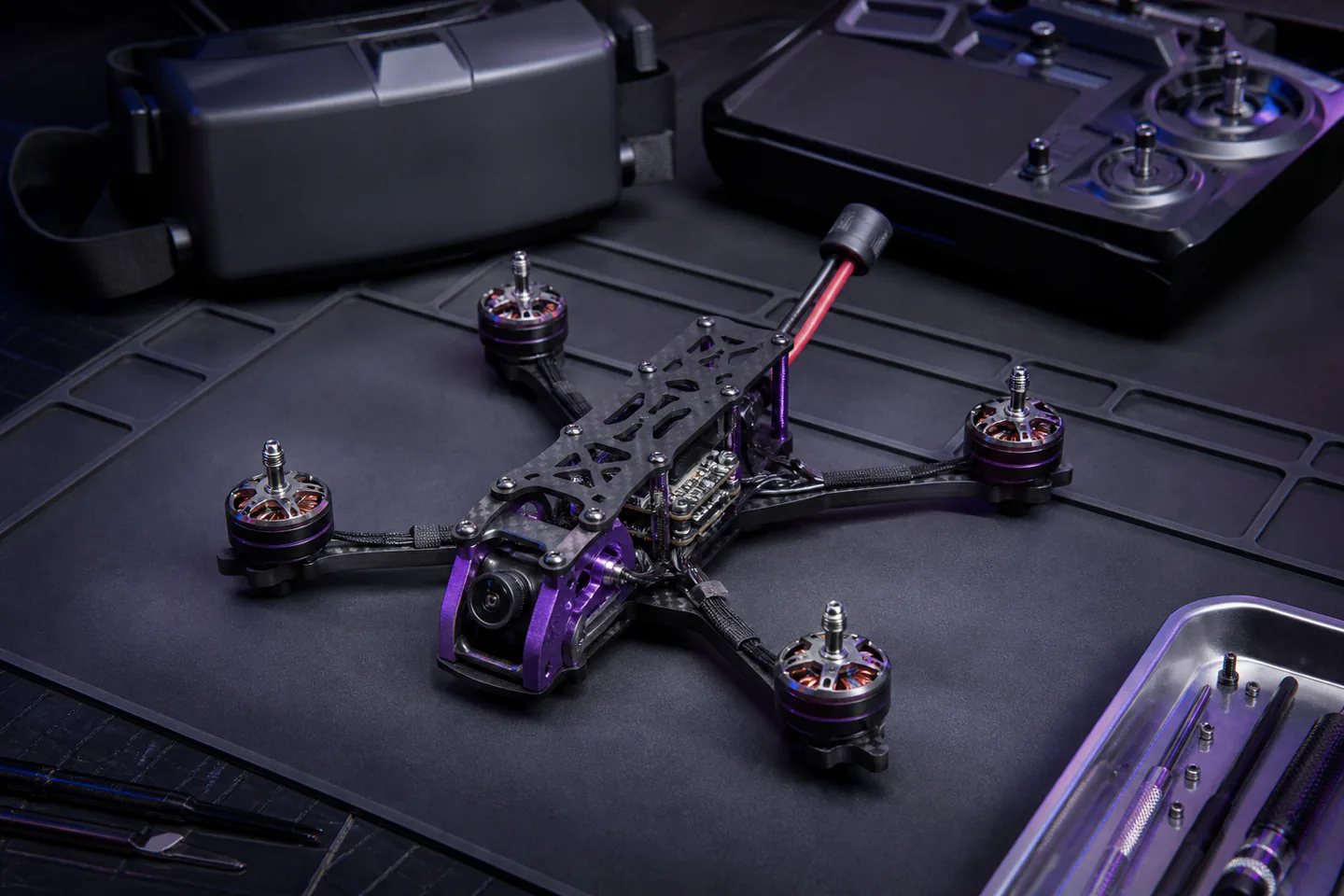
A custom five-inch quad is faster, heavier, louder and more dangerous than a ducted micro, and it needs soldering, configuration and a suitable field.
What to expect
The hobby combines flying, electronics and regulation
A ready-to-fly kit removes many compatibility decisions, but it does not remove practice, battery care, spotter requirements or responsibility for the location.
Simulator
Virtual practice saves props and helps build disarm reflexes, but it cannot reproduce every weight, latency or wind condition.
Protocol
Radio, receiver and sometimes goggles must use compatible systems; a similar product name can hide a different variant.
Video
Analogue video is inexpensive and low-latency but noisy; digital systems cost more and have their own compatible cameras and goggles.
Batteries
LiPo cells need a compatible balance charger, correct current, storage voltage and fire-aware charging location.
Repairs
Props and ducts are consumable; motors, flight controllers and connectors require diagnosis rather than blind swapping.
Rules
Airspace, people, property, privacy and club arrangements change what is lawful and considerate at each site.
Core method
Build skill and compatibility before building the aircraft
Choose one radio ecosystem deliberately
The BETAFPV Cetus X kit is sold in variants, so confirm Betaflight version, ExpressLRS frequency, goggles, transmitter and included batteries on the exact listing. If buying a separate RadioMaster Pocket, choose the ELRS variant only for ELRS receivers. Do not assume a colour or bundle photograph identifies the protocol.
Practise arming, disarming and orientation
Set the radio mode and switches consistently, then use a simulator to hover, make coordinated turns and disarm immediately after a crash. Learn the difference between angle, horizon and acro modes. Begin real flight with propellers inspected, people clear and the quad pointed away on a level surface.
Treat batteries as an operating system
Inspect every pack for swelling, dents, damaged leads or unusual heat. Use only a compatible charger and connector, charge on a non-combustible surface within sight and return packs to storage voltage after the session. Let warm packs cool before charging and transport terminals protected.
Plan the custom build from a complete parts list
Only after repeated flight and repairs, choose a frame size and voltage, then match motor KV, prop, ESC current, flight-controller layout, receiver, video system and battery. Draw the wiring, confirm mounting patterns and connector direction, dry-fit parts and smoke-test with current limiting before fitting props.
Useful products
Products with a clear job in the setup
The Cetus X is the complete first route. The RadioMaster Pocket is a better long-term control option when bought in the matching ELRS variant. The SpeedyBee stack illustrates a later 30 × 30 mm custom-build core; it is not an upgrade that fits the Cetus frame.
BETAFPV Cetus X FPV Kit, Betaflight ELRS Version
It supports real FPV practice and basic Betaflight learning without making soldering the price of entry.
RadioMaster Pocket Radio Controller, ELRS Version
EdgeTX and ELRS support make it more expandable than many closed kit transmitters while retaining compact size.
SpeedyBee F405 V4 Flight Controller and 55A BLHeli_S ESC Stack
It has strong documentation and common mounting for a planned five-inch-class build after soldering and configuration skills develop.
First project
Complete a safe micro-drone practice circuit
The first goal is repeatable control and disarming, not speed, height or cinematic footage.
- 01
Check current CAA requirements
Use the aircraft weight, camera and intended location to confirm registration, competency and operating rules.
- 02
Verify every variant
Match radio protocol, frequency, receiver, goggles, charger, connector and battery count.
- 03
Configure the disarm switch
Make it easy to reach and practise using it instantly in the simulator.
- 04
Inspect and charge
Check props and frame and charge intact packs with the exact compatible equipment.
- 05
Fly a low circuit
Hover, turn left and right, pass a clear marker and land before concentration fades.
- 06
Log faults and storage-charge
Record crashes, replace damaged props and return usable LiPos to storage voltage.
What can wait
What can wait until the first result
The expensive exciting parts become useful only when the radio, pilot and safety process are dependable.
- 01
A custom five-inch build
It adds soldering, exposed props, high-current power and much greater impact energy.
- 02
High-output video transmitters
Transmission power and frequency use are regulated and extra range does not create permission to fly.
- 03
A large pile of unmatched parts
Frame, stack, motor, battery, receiver and video compatibility must be planned as one system.
- 04
Flying alone in goggles
Follow the current FPV observer and operating requirements and never use goggles to ignore people or airspace.
- 05
Charging unattended
LiPo incidents escalate quickly; charging belongs on a suitable surface under active supervision.
Upgrade path
Upgrade the repeated limitation
Upgrade only when a specific limitation—radio ergonomics, video quality, wind performance or repairability—has repeated.
Simulator practice
Free–£25 plus radioComputer + compatible controller
Learn control and disarm reflexes cheaply.Cetus X RTF kit
About £245Micro quad + radio + goggles + batteries
Fly a coherent low-mass system.Long-term ELRS radio
About £70–£100RadioMaster Pocket + matched receivers
Use one controller across future aircraft.Custom five-inch quad
About £350–£800+Frame + motors + stack + video + tools
Gain performance with major safety and repair demands.Safety & care
Props, LiPos, radio links and airspace all need active control
An FPV quad can injure people, start a battery fire, interfere with others or break aviation rules even when the electronics work perfectly.
- Check the current UK CAA Drone Code, local restrictions, landowner permission and FPV observer requirements before flight.
- Remove propellers for bench configuration and motor testing; treat an armed quad as capable of starting without warning.
- Charge only intact LiPo batteries with a compatible balance charger on a non-combustible surface within sight and store at the recommended voltage.
- Set and test failsafe, arm/disarm controls and receiver link at low risk before every new build or major configuration change.
- Use eye protection, ventilation and competent soldering practice; current-limit the first power-up and stop immediately at smoke, heat or unexpected motor movement.
Outside help
When outside help earns its place
Simulator and an RTF manual start the skill, but a recognised FPV or model-flying club can provide a lawful field, observer practice and experienced inspection before a custom quad’s first flight.
Recheck current legal and operating requirements rather than relying on a video’s publication date.
Confirm the field rules, club insurance, observer practice and whether custom builds can be inspected.
Representative UK product, club, lesson and venue costs checked 9 August 2026; local prices, access, weather, materials and tutor support vary.
Sources
Where the guidance came from
Current aviation rules and manufacturer manuals take priority; Betaflight documentation and experienced FPV communities support configuration and fault patterns.
-
01
CAA · The Drone Code
Current UK registration, competency and operating rules.
Open source -
02
FPV UK · FPV guidance
UK-specific FPV operating, insurance and Article 16 context.
Open source -
03
BETAFPV · Cetus X manual
Manufacturer setup, variants, batteries and operation.
Open source -
04
Betaflight · Documentation
Primary configuration, receiver, modes and failsafe guidance.
Open source -
05
Reddit · r/fpv
Recurring community reports on beginner kits, protocols, LiPos and repairs.
Open source -
06
Amazon UK · BETAFPV Cetus X FPV kit
Exact product page, model or ISBN, observed price and availability checked for this guide.
Open source -
07
Amazon UK · RadioMaster Pocket ELRS radio
Exact product page, model or ISBN, observed price and availability checked for this guide.
Open source -
08
Amazon UK · SpeedyBee F405 V4 stack
Exact product page, model or ISBN, observed price and availability checked for this guide.
Open source
Guide information and links checked 9 August 2026.