Beginner’s guide · Photograph & film
Plan the legal flight,
then make the photograph.
In the UK, registration duties changed in 2026 and depend on class, mass, camera and operation. Learn the current Drone Code before choosing a location or relying on an old sub-250 g summary.
Quick answer
Complete the legal and site plan before launch
Use the CAA’s current registration checker for the exact drone, obtain every required ID, study the Drone Code, check airspace and local land permissions, then make a short visual-line-of-sight flight in calm conditions with one planned high, oblique and top-down composition.
- 01
Do not rely on pre-2026 summaries of weight thresholds; use current CAA pages. Keep the first attempt narrow enough that preparation, the main action and the result can all be reviewed together.
- 02
Permission to fly in airspace does not automatically grant permission to take off from land. Keep the first attempt narrow enough that preparation, the main action and the result can all be reviewed together.
- 03
The aircraft must remain the first priority; the screen and photograph are secondary. Keep the first attempt narrow enough that preparation, the main action and the result can all be reviewed together.
- 04
Low battery, wind and a changed home point can turn a routine composition into an urgent recovery. Keep the first attempt narrow enough that preparation, the main action and the result can all be reviewed together.
What to expect
Aerial photography is aviation plus composition
A technically legal aircraft still needs a lawful site, current restrictions, safe separation and a pilot who can abandon the shot.
Registration
Class mark, mass, camera and operation affect the IDs and equipment duties. For drone photography, note what actually happened rather than relying on memory; that turns the next attempt into a controlled change instead of another guess.
Airspace
Temporary restrictions and flight-restriction zones must be checked close to the flight. For drone photography, note what actually happened rather than relying on memory; that turns the next attempt into a controlled change instead of another guess.
Wind
Conditions at height can differ from those at the launch point. For drone photography, note what actually happened rather than relying on memory; that turns the next attempt into a controlled change instead of another guess.
Camera
Small sensors reward good light and careful exposure more than aggressive editing. For drone photography, note what actually happened rather than relying on memory; that turns the next attempt into a controlled change instead of another guess.
Core method
Plan the flight as a sequence of decisions
Resolve the rules
Use current CAA decision pages for the exact aircraft and intended operation. For drone photography, note what actually happened rather than relying on memory; that turns the next attempt into a controlled change instead of another guess.
Survey the site
Check land permission, airspace, people, obstacles, wildlife, weather and emergency landing options. For drone photography, note what actually happened rather than relying on memory; that turns the next attempt into a controlled change instead of another guess.
Set the camera on the ground
Choose still format, exposure warning and simple composition before take-off. For drone photography, note what actually happened rather than relying on memory; that turns the next attempt into a controlled change instead of another guess.
Fly, capture and return early
Keep visual line of sight, make the planned frames and land with a conservative battery margin. For drone photography, note what actually happened rather than relying on memory; that turns the next attempt into a controlled change instead of another guess.
Useful products
Products with a clear job in the setup
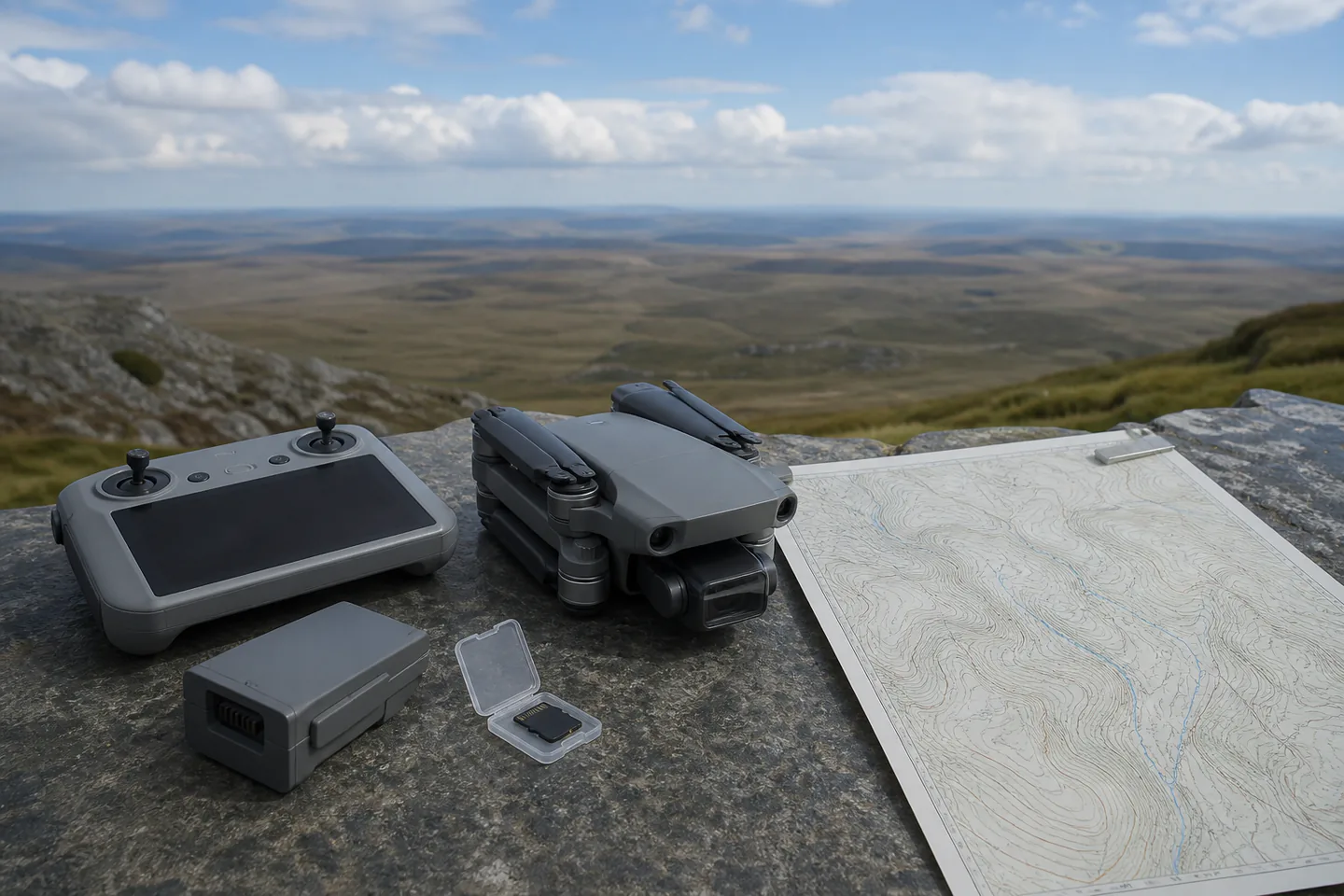
The DJI Mini 4K Fly More Combo is a complete aircraft ecosystem whose current UK class and registration duties must be checked. The SanDisk microSD card solves storage; no accessory makes an unsuitable site legal.
DJI Mini 4K Fly More Combo
The three-axis gimbal and spare batteries support deliberate stills practice.
SanDisk Ultra 64 GB microSDXC Card
A dedicated card makes transfer and backup simple.
First project
Make a three-angle landscape study
Use one legal open site and compare high oblique, lower oblique and straight-down viewpoints.
- 01
Complete the paperwork
Record IDs, aircraft details and current rule source. For drone photography, note what actually happened rather than relying on memory; that turns the next attempt into a controlled change instead of another guess.
- 02
Walk the site
Identify launch, people, obstacles, wildlife and abort points. For drone photography, note what actually happened rather than relying on memory; that turns the next attempt into a controlled change instead of another guess.
- 03
Set three compositions
Plan them before the propellers start. For drone photography, note what actually happened rather than relying on memory; that turns the next attempt into a controlled change instead of another guess.
- 04
Fly the short sequence
Maintain line of sight and position awareness. For drone photography, note what actually happened rather than relying on memory; that turns the next attempt into a controlled change instead of another guess.
- 05
Land and log
Back up files and record battery, wind and any unexpected condition. For drone photography, note what actually happened rather than relying on memory; that turns the next attempt into a controlled change instead of another guess.
What can wait
What can wait until the first result
Extra equipment becomes useful only when the basic method has exposed a specific, repeated limitation.
- 01
Golden-hour flight on day one
Low light and long shadows add exposure and visibility pressure. For drone photography, note what actually happened rather than relying on memory; that turns the next attempt into a controlled change instead of another guess.
- 02
Flying near buildings or crowds
Separation and subcategory rules become more consequential. For drone photography, note what actually happened rather than relying on memory; that turns the next attempt into a controlled change instead of another guess.
- 03
Automated subject tracking
Automation does not transfer legal responsibility from the pilot. For drone photography, note what actually happened rather than relying on memory; that turns the next attempt into a controlled change instead of another guess.
- 04
Paid work
Commercial context does not erase the same aviation and privacy duties. For drone photography, note what actually happened rather than relying on memory; that turns the next attempt into a controlled change instead of another guess.
Upgrade path
Upgrade the repeated limitation
Improve planning, batteries and camera capability only within the operation you can conduct safely.
Training and registration
Free plus current feesCAA study and required IDs
Understand the legal baseline.Sub-250 g camera drone
£250–£500Aircraft, controller and storage
Learn stable visual-line-of-sight capture.Extra batteries and ND filters
£50–£180Longer session and video shutter control
Expand deliberate shooting time.Larger sensor aircraft
£800–£2,500+Different class, capability and duties
Gain image quality with greater operational consequences.Safety & care
Current official rules outrank every buying guide
UK requirements changed in 2026 and can change again; check before each new aircraft and operation.
- Use the CAA registration checker and Drone Code current on the day of flight. Follow current manufacturer, food-safety, access, wildlife or local guidance wherever it applies.
- Check flight restrictions, temporary airspace notices and landowner conditions. Follow current manufacturer, food-safety, access, wildlife or local guidance wherever it applies.
- Maintain visual line of sight and prioritise aircraft control over the screen image. Follow current manufacturer, food-safety, access, wildlife or local guidance wherever it applies.
- Avoid disturbance to wildlife, livestock and people and respect privacy and data protection. Follow current manufacturer, food-safety, access, wildlife or local guidance wherever it applies.
- Inspect propellers and batteries, set a correct home point and land with a conservative reserve. Follow current manufacturer, food-safety, access, wildlife or local guidance wherever it applies.
Outside help
When outside help earns its place
The CAA’s official learning material is the first course; a practical lesson helps with site assessment, manual control and emergency procedures.
Complete every required current ID and keep details valid.
Ask about current UK classes, site planning, emergency handling and insurance.
Representative UK learning options checked 31 August 2026; local prices, access, materials and tutor support vary.
Sources
Where the guidance came from
Current CAA pages are the authority for the legal route; manufacturer documentation supports aircraft-specific setup and limitations.
-
01
CAA · Getting what you need to fly legally
Current 2026 UK registration and competency requirements.
Open source -
02
CAA · Registration requirements
Official decision route by aircraft and operation.
Open source -
03
CAA · Drone and Model Aircraft Code
Current operating rules and learning material.
Open source -
04
CAA · Airspace restrictions
Flight-restriction and airspace guidance.
Open source -
05
CAA · Flying in your local area
Land access, local restrictions and responsible site choice.
Open source -
06
DJI · Mini 4K
Manufacturer aircraft and camera specifications.
Open source -
07
Amazon UK · Mini 4K Fly More Combo
Exact Amazon UK product page or ISBN used for the recommendation; current price, seller, specification and availability should be confirmed.
Open source -
08
Amazon UK · Ultra 64 GB microSDXC Card
Exact Amazon UK product page or ISBN used for the recommendation; current price, seller, specification and availability should be confirmed.
Open source
Guide information and links checked 31 August 2026.