Beginner’s guide · Observe the sky
Site each sensor for the measurement,
then log before you compare.
Temperature, rainfall and wind need different exposures. A small station becomes useful when metadata, clock, units and maintenance are as consistent as the electronics.
Quick answer
Complete one weather dataset before expanding the setup
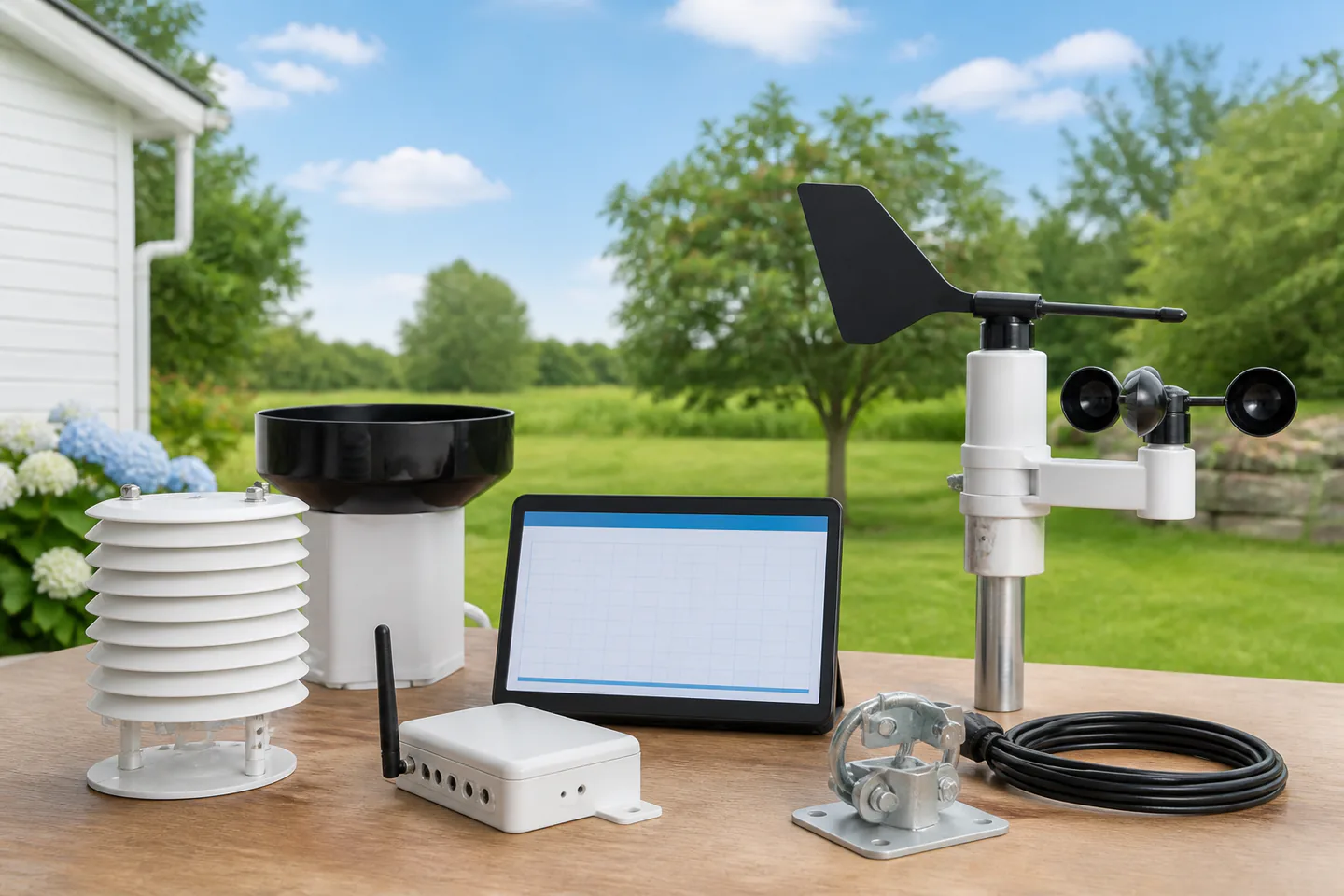
Start by logging temperature and rainfall with simple separate instruments at one authorised site. Draw the surroundings and measure sensor height and obstacle distances, shield the thermometer from radiation with airflow, mount the rain-gauge rim level in open exposure, synchronise clocks and units, record manual checks for one month and only then add wind sensors or automatic upload.
- 01
Sensor siting is part of the measurement; a precise biased reading is still biased. Record what happened during home weather station building so the next attempt changes one known variable instead of several guesses.
- 02
Temperature needs shade and ventilation, rainfall needs level open exposure and wind ideally needs height and clear fetch. Record what happened during home weather station building so the next attempt changes one known variable instead of several guesses.
- 03
Metadata about height, obstructions, surface, calibration and maintenance makes data interpretable. Record what happened during home weather station building so the next attempt changes one known variable instead of several guesses.
- 04
An amateur station is useful for local comparison but does not automatically meet official climate-record standards. Record what happened during home weather station building so the next attempt changes one known variable instead of several guesses.
What to expect
What home weather station building is really like at the start
The useful beginner controls are preparation, one bounded task and a record of the result; specialist equipment matters only when it solves a repeated limitation.
Temperature
Walls, paving, roofs and direct radiation can raise readings far above representative air temperature. Record what happened during home weather station building so the next attempt changes one known variable instead of several guesses.
Rain
Splash, turbulence, blockage and an unlevel gauge produce systematic error. Record what happened during home weather station building so the next attempt changes one known variable instead of several guesses.
Wind
Buildings and trees accelerate, shelter and redirect flow differently by direction. Record what happened during home weather station building so the next attempt changes one known variable instead of several guesses.
Data
Clock drift, battery loss, unit conversion and sensor resets create gaps and false spikes. Record what happened during home weather station building so the next attempt changes one known variable instead of several guesses.
Core method
The core home weather station building method
Survey the site
Map surfaces, heights, obstructions, access, power, radio path and maintenance safety. Record what happened during home weather station building so the next attempt changes one known variable instead of several guesses.
Install one variable well
Begin with a shielded thermometer or level gauge and document exact height and exposure. Record what happened during home weather station building so the next attempt changes one known variable instead of several guesses.
Validate and maintain
Compare manual observations, inspect after storms and record cleaning, battery and position changes. Record what happened during home weather station building so the next attempt changes one known variable instead of several guesses.
Automate cautiously
Set timestamps, units, missing-data rules and privacy controls before upload or analysis. Record what happened during home weather station building so the next attempt changes one known variable instead of several guesses.
Useful products
Products with a clear job in the route
The maximum-minimum thermometer starts a manual temperature record, the notebook keeps metadata and the caliper helps document gauge and mounting dimensions; choose integrated sensors only after the site survey.
Silvine A5 Executive Dotted Hardback Notebook
A durable small notebook is quicker to annotate than rebuilding events from memory.
Kynup Digital Caliper, 150 mm
It makes small fit differences visible instead of relying on feel.
3M SecureFit 200 Safety Glasses
They are easy to keep at the bench for routine impact risks.
First project
Log temperature and rainfall for thirty days
Use fixed local observation times, complete site metadata and manual checks before adding a dashboard.
- 01
Draw the exposure
Record sensor height, surfaces and obstacle distance and height. Record what happened during home weather station building so the next attempt changes one known variable instead of several guesses.
- 02
Install and label
Mount securely, level where required and keep the site identifier private if necessary. Record what happened during home weather station building so the next attempt changes one known variable instead of several guesses.
- 03
Synchronise time and units
Use one time standard and record daylight-saving handling. Record what happened during home weather station building so the next attempt changes one known variable instead of several guesses.
- 04
Observe and maintain
Check daily, clean carefully and log every intervention and outage. Record what happened during home weather station building so the next attempt changes one known variable instead of several guesses.
- 05
Review the month
Flag spikes, gaps and siting biases before comparing with another station. Record what happened during home weather station building so the next attempt changes one known variable instead of several guesses.
What can wait
What can wait until the first result
Delay anything that adds cost, risk or another variable before the basic workflow has produced something you can review.
- 01
A rooftop temperature sensor
Roof heat and exposure can make it unrepresentative of near-surface air. Record what happened during home weather station building so the next attempt changes one known variable instead of several guesses.
- 02
Automatic public upload
Data quality, credentials and exact home location need review first. Record what happened during home weather station building so the next attempt changes one known variable instead of several guesses.
- 03
A mast at height
Working at height, wind load and lightning protection need competent design. Record what happened during home weather station building so the next attempt changes one known variable instead of several guesses.
- 04
Calling records official
Formal climatological records use controlled instruments, siting and quality assurance. Record what happened during home weather station building so the next attempt changes one known variable instead of several guesses.
Upgrade path
Add the capability you can now name
Each stage should remove a demonstrated constraint rather than make the setup look more advanced.
Use what you own
£0–£20Existing equipment and one written plan
Use one manual sensor and a documented site.Repeat the first route
About £40–£250A complete repeatable starter setup
Build a reliable temperature and rainfall record.Add one capability
Often £50–£250One selected tool, service or learning resource
Add wind, pressure or automatic logging for a specific question.Build specialist depth
Club, course or specialist dependentA documented specialist workflow
Develop calibrated instruments, robust power and analysis with a weather-observer group.Safety & care
Do not trade data quality for a risky mounting point
Electrical weatherproofing, ladders, masts, lightning and public location data require competent boundaries.
- Do not work on roofs, high masts or near overhead lines without competent equipment, planning and assistance.
- Use outdoor-rated enclosures, cable entries, power supplies and residual-current protection as applicable.
- Design mounts for wind load and falling-object risk and inspect them after severe weather.
- Keep station credentials private and consider reducing location precision before public upload from a home.
- Record calibration, moves, obstruction changes and outages and do not claim professional accuracy without traceable evidence.
Outside help
When outside help earns its place
A local weather-observer or electronics group helps with siting comparison, calibration, logging and safe outdoor installation.
Bring the site sketch and ask how each proposed sensor position biases the intended measurement.
Use outside help after the first home weather station building attempt can reveal the exact technique, access or safety problem that needs live correction.
Representative UK learning and access routes checked 1 September 2026; local prices, permissions, equipment and tutor support vary.
Sources
Where the guidance came from
Authoritative and specialist guidance supports the method and safety boundaries; community discussion contributes recurring beginner problems rather than unsupported claims.
-
01
Met Office WOW · Site ratings
Exposure, obstruction, temperature, rainfall and wind siting grades.
Open source -
02
Met Office WOW · Support
Station siting, metadata and observation support.
Open source -
03
Met Office · Weather stations
Official-station measurements, placement and quality context.
Open source -
04
Met Office · How we measure wind
Height, roughness and obstruction effects on wind.
Open source -
05
Royal Meteorological Society · Weather observing
Amateur observation, instruments and meteorological context.
Open source -
06
Reddit · r/myweatherstation
Community evidence on siting, radio links, batteries and data logging.
Open source -
07
Amazon UK · A5 Executive Dotted Hardback Notebook
Exact Amazon UK product page or ISBN used for this recommendation; current price, seller, specification and availability should be confirmed.
Open source -
08
Amazon UK · Digital Caliper, 150 mm
Exact Amazon UK product page or ISBN used for this recommendation; current price, seller, specification and availability should be confirmed.
Open source -
09
Amazon UK · SecureFit 200 Safety Glasses
Exact Amazon UK product page or ISBN used for this recommendation; current price, seller, specification and availability should be confirmed.
Open source
Guide information and links checked 1 September 2026.