Beginner’s guide · Collect & curate
Collect one theme
and identify every stamp.
Stamp collecting starts with a narrow theme, clean handling, trustworthy identification and storage that protects gum, perforations and provenance.
Quick answer
Define a small collecting rule before buying examples
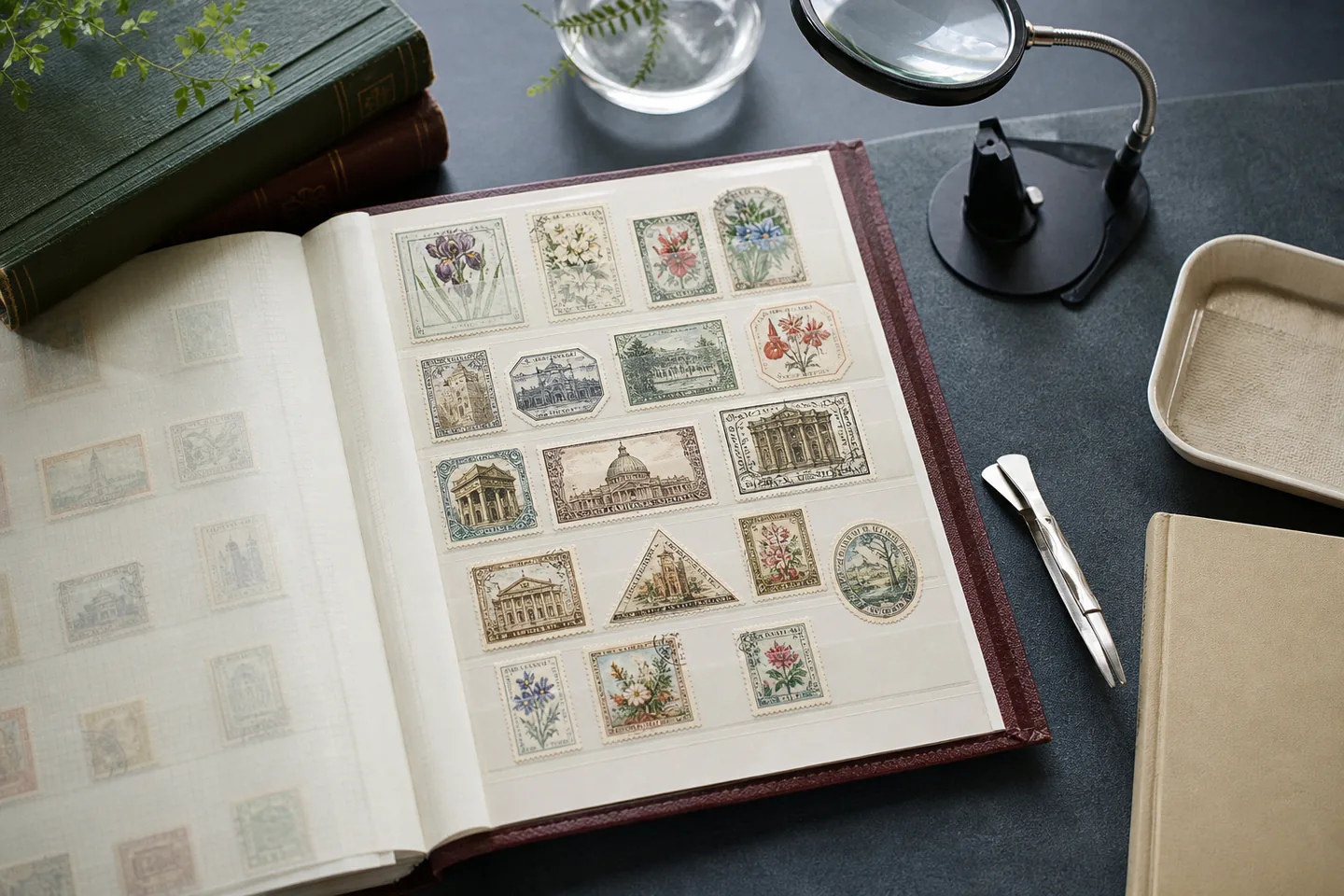
Choose one country, period or theme and build a small page from inexpensive common stamps. Identify issue, date, denomination and condition with a current catalogue, handle with tongs and store in a stockbook before buying a rare example.
- 01
Define the theme, budget and condition terms, then prepare a clean dry workspace, stockbook, tongs, magnifier and identification references. Keep the first attempt narrow enough that preparation, the main action and the result can all be reviewed together.
- 02
Handle every stamp by tongs, compare perforation, watermark, colour and cancellation systematically and keep unverified claims out of the catalogue record. Keep the first attempt narrow enough that preparation, the main action and the result can all be reviewed together.
- 03
Assess centring, tears, thins, creases, missing perforations, gum disturbance, cancellation and whether provenance supports the identification. Keep the first attempt narrow enough that preparation, the main action and the result can all be reviewed together.
- 04
Return stamps to protective storage, update acquisition and identification notes and quarantine damp, mouldy or adhesive-contaminated material. Keep the first attempt narrow enough that preparation, the main action and the result can all be reviewed together.
What to expect
Identification and condition matter more than quantity
A modest documented collection is easier to understand, protect and enjoy than an unexplained accumulation.
The first attempt
Common used stamps reveal printing, perforations and postmarks without the financial risk of learning condition on scarce material. For stamp collecting, note what actually happened rather than relying on memory; that turns the next attempt into a controlled change instead of another guess.
The control point
Handle every stamp by tongs, compare perforation, watermark, colour and cancellation systematically and keep unverified claims out of the catalogue record. For stamp collecting, note what actually happened rather than relying on memory; that turns the next attempt into a controlled change instead of another guess.
The useful signal
Assess centring, tears, thins, creases, missing perforations, gum disturbance, cancellation and whether provenance supports the identification. For stamp collecting, note what actually happened rather than relying on memory; that turns the next attempt into a controlled change instead of another guess.
The common trap
Bulk mystery lots and confident online labels can turn duplicates, damaged stamps and misidentifications into an expensive pile. For stamp collecting, note what actually happened rather than relying on memory; that turns the next attempt into a controlled change instead of another guess.
Core method
Choose a theme, identify, protect and record
Prepare deliberately
Define the theme, budget and condition terms, then prepare a clean dry workspace, stockbook, tongs, magnifier and identification references. For stamp collecting, note what actually happened rather than relying on memory; that turns the next attempt into a controlled change instead of another guess.
Control the central variable
Handle every stamp by tongs, compare perforation, watermark, colour and cancellation systematically and keep unverified claims out of the catalogue record. For stamp collecting, note what actually happened rather than relying on memory; that turns the next attempt into a controlled change instead of another guess.
Read the result
Assess centring, tears, thins, creases, missing perforations, gum disturbance, cancellation and whether provenance supports the identification. For stamp collecting, note what actually happened rather than relying on memory; that turns the next attempt into a controlled change instead of another guess.
Reset before repeating
Return stamps to protective storage, update acquisition and identification notes and quarantine damp, mouldy or adhesive-contaminated material. For stamp collecting, note what actually happened rather than relying on memory; that turns the next attempt into a controlled change instead of another guess.
Useful products
Products with a clear job in the setup
A closed archival-style album, stand magnifier and precision tweezers illustrate storage and inspection jobs; purpose-made stamp tongs and mounts should come from a philatelic supplier.
Lanpn 12 × 12 Archival Top-Load Album
It helps a beginner decide between fixed pages, stockbooks and display sleeves.
Carson LL-10 10× LumiLoupe Stand Magnifier
A stand keeps the view stable without touching the stamp.
MMOBIEL Seven-Piece Precision Tweezer Set
It may help with mounts, but philatelic tongs have broad smooth tips designed for stamps.
First project
Build one labelled thematic stockbook page
Use inexpensive examples and record what is known, uncertain and still to research.
- 01
Set up
Define the theme, budget and condition terms, then prepare a clean dry workspace, stockbook, tongs, magnifier and identification references. For stamp collecting, note what actually happened rather than relying on memory; that turns the next attempt into a controlled change instead of another guess.
- 02
Begin the first attempt
Common used stamps reveal printing, perforations and postmarks without the financial risk of learning condition on scarce material. For stamp collecting, note what actually happened rather than relying on memory; that turns the next attempt into a controlled change instead of another guess.
- 03
Hold one variable steady
Handle every stamp by tongs, compare perforation, watermark, colour and cancellation systematically and keep unverified claims out of the catalogue record. For stamp collecting, note what actually happened rather than relying on memory; that turns the next attempt into a controlled change instead of another guess.
- 04
Inspect the result
Assess centring, tears, thins, creases, missing perforations, gum disturbance, cancellation and whether provenance supports the identification. For stamp collecting, note what actually happened rather than relying on memory; that turns the next attempt into a controlled change instead of another guess.
- 05
Reset and record
Return stamps to protective storage, update acquisition and identification notes and quarantine damp, mouldy or adhesive-contaminated material. For stamp collecting, note what actually happened rather than relying on memory; that turns the next attempt into a controlled change instead of another guess.
What can wait
What can wait until the first result
Delay expensive rarities and bulk lots until identification and storage are dependable.
- 01
A large first setup
Scale multiplies Bulk mystery lots and confident online labels can turn duplicates, damaged stamps and misidentifications into an expensive pile. before the basic routine is known. For stamp collecting, note what actually happened rather than relying on memory; that turns the next attempt into a controlled change instead of another guess.
- 02
Premium specialist equipment
It should solve a limitation you can describe after several stamp collecting sessions. For stamp collecting, note what actually happened rather than relying on memory; that turns the next attempt into a controlled change instead of another guess.
- 03
Several methods at once
Changing materials and technique together makes the cause of a result hard to see. For stamp collecting, note what actually happened rather than relying on memory; that turns the next attempt into a controlled change instead of another guess.
- 04
Buying for a future version
Finish and review the small route before equipping an imagined advanced practice. For stamp collecting, note what actually happened rather than relying on memory; that turns the next attempt into a controlled change instead of another guess.
Upgrade path
Upgrade the repeated limitation
Upgrade reference depth and protection before collection size.
Try it
About £20–£70Common stamps, stockbook and tongs
Complete one meaningful result and learn the whole sequence.Repeat it
About £20–£70Current catalogue and magnifier
Reduce setup friction and compare several attempts.Improve the bottleneck
£100–£400Perforation gauge, watermark tools and better mounts
Address Bulk mystery lots and confident online labels can turn duplicates, damaged stamps and misidentifications into an expensive pile. with a targeted change.Go deeper
VariableSpecialist society, expertisation and provenance files
Add scale, precision or public participation with evidence from practice.Safety & care
Protect fragile paper and the collecting budget
Humidity, adhesives, overconfident identification and counterfeit material cause more damage than ordinary handling when basic controls are sound.
- Use purpose-made stamp tongs and archival storage; avoid tape, glue and improvised laminating. Follow current manufacturer, food-safety, access, wildlife or local guidance wherever it applies.
- Keep collections away from damp, direct sun, food, smoke and rapid temperature changes. Follow current manufacturer, food-safety, access, wildlife or local guidance wherever it applies.
- Do not soak stamps from covers that may have postal-history value before specialist assessment. Follow current manufacturer, food-safety, access, wildlife or local guidance wherever it applies.
- Research sellers, returns, certificates and market price before expensive purchases. Follow current manufacturer, food-safety, access, wildlife or local guidance wherever it applies.
- Set a budget and cooling-off rule so collecting remains an informed hobby rather than financial harm. Follow current manufacturer, food-safety, access, wildlife or local guidance wherever it applies.
Outside help
When outside help earns its place
The Royal Philatelic Society London and local societies help with catalogues, expertisation, postal history and ethical buying.
Use one complete lesson that covers preparation, the central technique, common mistakes and finishing. For a first stamp collecting attempt, one coherent method is easier to diagnose than fragments collected from several creators.
Outside help earns its place when safe setup, access, identification or live correction removes a real obstacle. Ask what equipment, materials, access and follow-up support are included before booking.
Representative UK learning options checked 31 August 2026; local prices, access, materials and tutor support vary.
Sources
Where the guidance came from
The method is grounded in specialist, manufacturer and public guidance, then checked against recurring beginner problems and the exact products linked here.
-
01
Royal Philatelic Society London
UK philatelic research, expertise and learning.
Open source -
02
American Philatelic Society · Getting started
Beginner collecting, identification and care.
Open source -
03
Stanley Gibbons · Collecting guides
UK catalogues, condition and collecting context.
Open source -
04
Royal Mail · Stamp issues
Current UK stamp-issue context.
Open source -
05
Reddit · r/philately
Community evidence on albums, tongs, identification and buying.
Open source -
06
Amazon UK · 12 × 12 Archival Top-Load Album
Exact Amazon UK product page or ISBN used for the recommendation; current price, seller, specification and availability should be confirmed.
Open source -
07
Amazon UK · LL-10 10× LumiLoupe Stand Magnifier
Exact Amazon UK product page or ISBN used for the recommendation; current price, seller, specification and availability should be confirmed.
Open source -
08
Amazon UK · Seven-Piece Precision Tweezer Set
Exact Amazon UK product page or ISBN used for the recommendation; current price, seller, specification and availability should be confirmed.
Open source
Guide information and links checked 31 August 2026.