Beginner’s guide · Cook & bake
Let alcohol become acid
without sealing away oxygen.
Begin with a small batch of cider or wine vinegar from a known alcoholic base and an active vinegar culture. Airflow, time and measured acidity matter more than elaborate vessels.
Quick answer
Start from cider, not fresh fruit
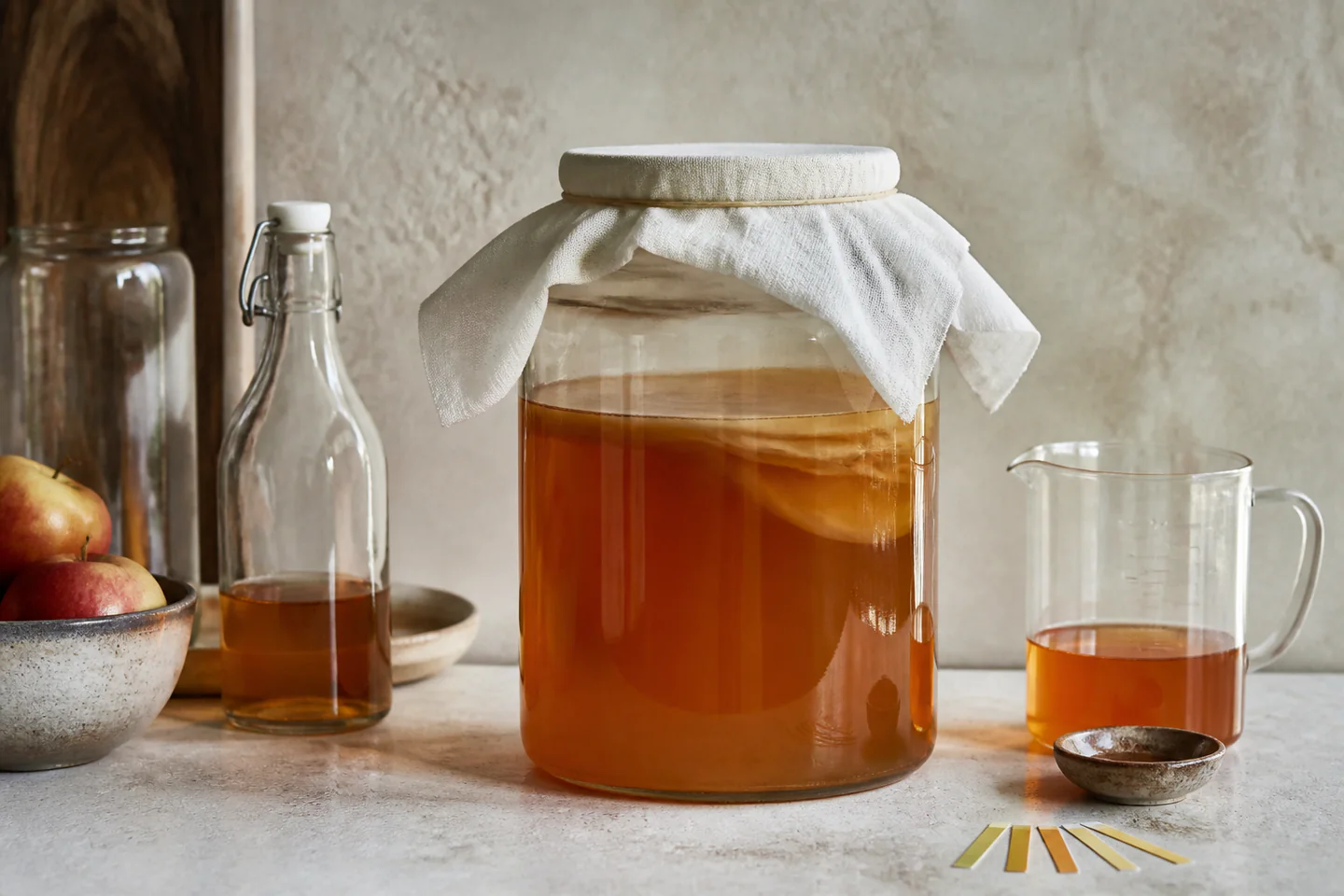
Use an unflavoured alcoholic cider or wine, a clean wide vessel and live unpasteurised vinegar or a vinegar mother. Cover against insects while allowing oxygen, taste only with clean utensils and bottle once conversion is complete.
- 01
Acetic-acid bacteria need oxygen, so this is not an airlocked fermentation. Keep the first attempt narrow enough that preparation, the main action and the result can all be reviewed together.
- 02
Begin from a known alcoholic liquid rather than trying to run yeast and vinegar stages together. Keep the first attempt narrow enough that preparation, the main action and the result can all be reviewed together.
- 03
Keep fruit flies out with a secure breathable cover. Keep the first attempt narrow enough that preparation, the main action and the result can all be reviewed together.
- 04
Measure and label the result; homemade vinegar is not automatically suitable for preserving food. Keep the first attempt narrow enough that preparation, the main action and the result can all be reviewed together.
What to expect
The surface culture can look strange without being mould
A smooth translucent cellulose pellicle is common, while fuzzy coloured growth, rotten odours or insect contamination are reasons to discard.
Time
Conversion commonly takes weeks rather than days, with temperature and surface area affecting speed. For vinegar making, note what actually happened rather than relying on memory; that turns the next attempt into a controlled change instead of another guess.
Aroma
The alcoholic smell recedes and a clean sharp vinegar aroma develops; solvent-like harshness may soften with age. For vinegar making, note what actually happened rather than relying on memory; that turns the next attempt into a controlled change instead of another guess.
Mother
A new pellicle may form even when liquid starter is used, but its appearance alone does not prove acidity. For vinegar making, note what actually happened rather than relying on memory; that turns the next attempt into a controlled change instead of another guess.
Strength
Taste and paper strips are approximate; preservation recipes require vinegar of known acidity. For vinegar making, note what actually happened rather than relying on memory; that turns the next attempt into a controlled change instead of another guess.
Core method
Give the culture clean air and a known substrate
Choose the base
Use plain cider, wine or diluted beer within the culture supplier’s alcohol range. For vinegar making, note what actually happened rather than relying on memory; that turns the next attempt into a controlled change instead of another guess.
Inoculate
Add active raw vinegar or mother according to a documented ratio and leave headspace. For vinegar making, note what actually happened rather than relying on memory; that turns the next attempt into a controlled change instead of another guess.
Cover
Secure tightly woven cloth or paper against flies while keeping the surface supplied with oxygen. For vinegar making, note what actually happened rather than relying on memory; that turns the next attempt into a controlled change instead of another guess.
Finish
When the alcohol character has gone, assess acidity, decant cleanly and store sealed away from heat. For vinegar making, note what actually happened rather than relying on memory; that turns the next attempt into a controlled change instead of another guess.
Useful products
Tools that make the process measurable
These products earn a place by controlling a specific variable. Ordinary kitchen equipment can cover the rest; check capacities, materials and current availability before ordering.
Kilner One-Litre Clip-Top Glass Jar
The wide surface supports oxygen transfer and the glass shows contamination.
Fermentaholics Kombucha pH Test Strip Roll
It can show movement into an acidic range without proving percentage acetic acid.
Salter 1036 Digital Kitchen Scale
A written base-to-starter ratio is easier to reproduce than eyeballing.
First project
Convert one bottle of plain cider
The first batch is for salad dressing and cooking after refrigeration, not an unverified preserving vinegar.
- 01
Prepare
Clean a wide jar, cover and utensils; choose a plain alcoholic base without preservatives that inhibit the culture. For vinegar making, note what actually happened rather than relying on memory; that turns the next attempt into a controlled change instead of another guess.
- 02
Dilute if required
Follow the culture instructions to bring stronger wine into a workable alcohol range. For vinegar making, note what actually happened rather than relying on memory; that turns the next attempt into a controlled change instead of another guess.
- 03
Inoculate
Add active vinegar culture, cover securely and label the base, quantities and date. For vinegar making, note what actually happened rather than relying on memory; that turns the next attempt into a controlled change instead of another guess.
- 04
Wait and assess
Leave warm and dark with airflow, checking for a clean aroma and protected surface. For vinegar making, note what actually happened rather than relying on memory; that turns the next attempt into a controlled change instead of another guess.
- 05
Bottle
Decant once conversion is complete, reserve healthy culture for the next batch and store the vinegar sealed. For vinegar making, note what actually happened rather than relying on memory; that turns the next attempt into a controlled change instead of another guess.
What can wait
What can wait until the first result
Trying to prove canning strength or run several fermentation stages at once creates unnecessary uncertainty.
- 01
Fresh-fruit mash
Run alcoholic fermentation separately before vinegar conversion. For vinegar making, note what actually happened rather than relying on memory; that turns the next attempt into a controlled change instead of another guess.
- 02
Decorative narrow bottles
Surface area and cleaning matter more than appearance. For vinegar making, note what actually happened rather than relying on memory; that turns the next attempt into a controlled change instead of another guess.
- 03
Long ageing
First prove clean conversion and stable storage. For vinegar making, note what actually happened rather than relying on memory; that turns the next attempt into a controlled change instead of another guess.
- 04
Pickling claims
Use commercial vinegar of stated acidity for tested preservation recipes. For vinegar making, note what actually happened rather than relying on memory; that turns the next attempt into a controlled change instead of another guess.
Upgrade path
Upgrade the repeated limitation
Upgrade observation and acidity measurement only after a clean batch succeeds.
Try it
£15–£40Small jar, known alcoholic base and active culture
You learn the conversion rhythm.Repeat it
MinimalReserved starter and written ratios
Success stops depending on an accidental mother.Measure better
£20–£100Calibrated pH meter plus titration learning
Acidity trends become clearer, though preservation still needs validated methods.Age selectively
£10–£50Full sealed bottles in stable storage
Harsh edges can soften without risking the active batch.Safety & care
Keep homemade vinegar out of tested canning substitutions
Acid taste, low pH and percent acetic acid are related but not interchangeable measurements.
- Exclude fruit flies and discard insect-contaminated batches. Follow current manufacturer, food-safety, access, wildlife or local guidance wherever it applies.
- Discard fuzzy, coloured mould or putrid fermentation rather than scraping it away. Follow current manufacturer, food-safety, access, wildlife or local guidance wherever it applies.
- Use food-compatible glass or suitable plastic, not reactive metal. Follow current manufacturer, food-safety, access, wildlife or local guidance wherever it applies.
- Do not tightly seal the active aerobic conversion stage. Follow current manufacturer, food-safety, access, wildlife or local guidance wherever it applies.
- Use commercial vinegar of the specified acidity in tested pickling and canning recipes. Follow current manufacturer, food-safety, access, wildlife or local guidance wherever it applies.
Outside help
When outside help earns its place
A class is optional, but useful when tasting a known-good example or seeing sanitation and consistency demonstrated would shorten the learning curve.
Use one complete lesson that covers preparation, the central technique, common mistakes and finishing. For a first vinegar making attempt, one coherent method is easier to diagnose than fragments collected from several creators.
Outside help earns its place when safe setup, access, identification or live correction removes a real obstacle. Ask what equipment, materials, access and follow-up support are included before booking.
Representative UK learning options checked 31 August 2026; local prices, access, materials and tutor support vary.
Sources
Where the guidance came from
The method is grounded in specialist, manufacturer and public guidance, then checked against recurring beginner problems and the exact products linked here.
-
01
Penn State Extension · Making cider vinegar at home
Extension process and safety guidance.
Open source -
02
National Center for Home Food Preservation · Pickling
Why known vinegar acidity matters in preservation.
Open source -
03
Food Standards Agency · Food safety at home
UK hygiene and storage baseline.
Open source -
04
Supreme Vinegar · How to make vinegar
Specialist conversion, alcohol and culture guidance.
Open source -
05
r/fermentation
Real-world pellicle, fruit-fly and stalled-batch questions.
Open source -
06
Amazon UK · One-Litre Clip-Top Glass Jar
Exact Amazon UK product page or ISBN used for the recommendation; current price, seller, specification and availability should be confirmed.
Open source -
07
Amazon UK · Kombucha pH Test Strip Roll
Exact Amazon UK product page or ISBN used for the recommendation; current price, seller, specification and availability should be confirmed.
Open source -
08
Amazon UK · 1036 Digital Kitchen Scale
Exact Amazon UK product page or ISBN used for the recommendation; current price, seller, specification and availability should be confirmed.
Open source
Guide information and links checked 31 August 2026.