Beginner’s guide · Cook & bake
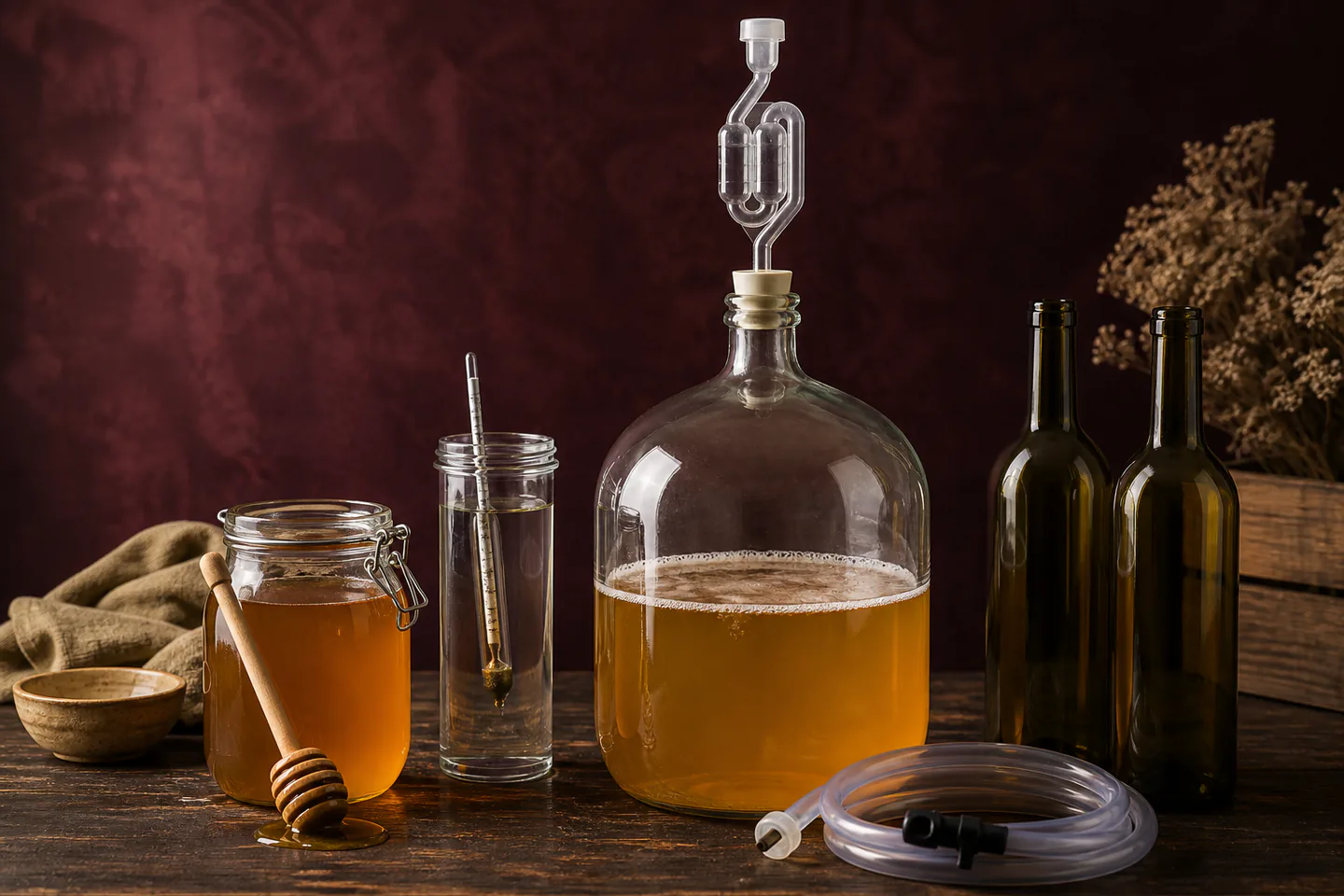
A one-gallon traditional mead with recorded gravity
Honey begins the recipe; yeast management finishes it.
Start with a small traditional mead, a sanitised demijohn, a brewing hydrometer, known wine yeast and a nutrient schedule from a tested recipe. Expect fermentation and ageing, not instant honey wine.
Quick answer
Follow one modern one-gallon recipe without guessing nutrients
Choose a tested beginner traditional-mead recipe that specifies honey mass, final volume, yeast, nutrient product, additions and temperature. Clean and sanitise a one-gallon fermenter and every contact tool, dissolve honey in safe drinking water without unnecessary boiling, measure original gravity, pitch a suitable rehydrated wine yeast and follow the recipe’s nutrient schedule. Degas or aerate only as directed early in fermentation, then protect from oxygen, confirm stable final gravity and age before packaging.
- 01
Honey supplies sugar but little yeast-assimilable nitrogen. Modern recipes use a named nutrient plan rather than raisins as a reliable substitute.
- 02
Yeast choice and temperature change aroma, attenuation and ageing. D47 is popular but can be unforgiving when warm; match the room to the strain.
- 03
An airlock is not a completion meter. Stable hydrometer readings and the recipe schedule decide when fermentation has ended.
- 04
Sweetness is not safely controlled by bottling early. Stabilisation and backsweetening require correct process and do not make active fermentation harmless.
What to expect
Simple ingredients still create a demanding fermentation
Mead can look inactive, taste harsh when young and take months to become coherent. Notes and measurements prevent patience from becoming guesswork.
Honey
Use a flavour you enjoy and weigh it. Heating can change aroma, and different honeys create different gravity for the same volume.
Yeast
Select for temperature, alcohol tolerance and flavour, then store and rehydrate it according to the maker.
Nutrients
Use the exact named product and schedule in the recipe; substitutes have different nitrogen values and dosing.
Oxygen
Early aeration may support yeast, while post-fermentation splashing can stale the mead. The timing distinction matters.
Gravity
Original and stable final readings show progress and approximate alcohol; sweetness alone cannot prove safety.
Age
Hot alcohol, sulphur or disjointed sweetness may improve, but infection and severe oxidation do not become good through time.
Core method
Make a measured small batch and protect it from contamination
Choose recipe, yeast and temperature together
Find a current recipe from a recognised mead source and purchase its exact nutrient type rather than converting casually between DAP, Fermaid K and Fermaid O. Check the yeast’s recommended temperature against a measured storage location and choose a different strain if the room cannot stay suitable.
Clean, sanitise and record gravity
Remove residue from vessel, bung, airlock, spoon, funnel, hydrometer and sample jar, then sanitise to label instructions. Weigh honey and water to the recipe, mix thoroughly, bring to pitching temperature and record original gravity using a clean sample that is not returned.
Manage the active phase
Rehydrate and pitch yeast as instructed. Provide headspace or a covered primary vessel appropriate to the recipe because foaming can block an airlock. Add nutrients on schedule with careful degassing to avoid sudden foam; monitor temperature and stop oxygenating after the recipe’s early phase.
Confirm, rack and package
When gravity is stable across separated readings and the recipe’s time has passed, rack gently off gross sediment into a sanitised vessel with little headspace. Age as directed. Bottle only when fermentation is demonstrably complete, or use a validated stabilisation and backsweetening method before still packaging.
Useful products
A small fermenter, a known yeast and a modern reference
The MYPURECORE set supplies small-batch vessels and transfer tools, Lalvin D47 is a specific yeast only for suitably cool control, and Steve Piatz’s updated book provides broader recipes and troubleshooting. Nutrient and honey must still match the chosen recipe.
MYPURECORE Two 1 Gallon Glass Demijohns with Airlocks and Siphon Set
Two vessels make it possible to rack off sediment without buying a five-gallon system.
Lalvin ICV-D47 Wine Yeast, 5 g
It is widely documented and can retain varietal character when managed correctly.
Steve Piatz The Complete Guide to Making Mead, Updated Edition
Its updated edition covers nutrient and yeast choices alongside the complete small-batch process.
First project
Ferment one documented traditional mead
A small batch contains the cost while producing enough liquid for measurements, racking and later tasting.
- 01
Select the complete recipe
Confirm honey, yeast, nutrients, final volume, temperature and ageing plan.
- 02
Clean and sanitise
Treat every contact surface and leave safe headspace for the active phase.
- 03
Mix and measure
Weigh honey and water, homogenise, cool if necessary and record original gravity.
- 04
Pitch and feed yeast
Follow rehydration and the exact nutrient schedule without casual substitutions.
- 05
Prove final gravity
Take clean readings on separated days and do not use bubbles as the decision.
- 06
Rack and age
Minimise splashing, reduce headspace after fermentation and package only when stable.
What can wait
What can wait until the first result
Fruit, carbonation and high strength increase variables and pressure before a clean traditional mead exists.
- 01
Sparkling bottles
Carbonation requires calculated sugar, proven completion and pressure-rated packaging.
- 02
Very high gravity
More honey stresses yeast, lengthens ageing and makes nutrient and temperature errors more obvious.
- 03
Fruit in a narrow demijohn
Fruit can block openings and foam violently; use an appropriate wide primary and proven recipe.
- 04
Oak and many spices
Small additions can dominate and are easier to judge after the base mead is understood.
- 05
Early backsweetening
Adding honey to unstabilised mead can restart fermentation and create pressure.
Upgrade path
Upgrade the repeated limitation
Upgrade temperature control and measurement before buying elaborate vessels or bulk honey.
One-gallon traditional
About £55–£100Demijohn + hydrometer + recipe ingredients
Learn sanitation and fermentation.Temperature stability
About £60–£220 extraControlled chamber or heat/cool system
Match the selected yeast range.Repeatable transfers
About £30–£100 extraWide primary + auto-siphon + spare vessels
Reduce loss and improve ageing workflow.Recipe development
VariablepH tools + scales + multiple honeys
Compare deliberate changes after clean batches.Safety & care
Active yeast can create dangerous pressure
Sanitation, chemicals, glass, carbon dioxide and alcohol all require conservative handling.
- Never bottle because an airlock stopped; require stable hydrometer readings and a validated packaging method.
- Use pressure-rated bottles only for a calculated sparkling recipe and contain early conditioning in case a bottle fails.
- Inspect glass demijohns, carry them in a crate or harness and never lift a full wet vessel by its neck.
- Use nutrients, stabilisers and cleaners exactly to product and recipe instructions; never mix cleaning chemicals.
- Vent fermentation areas, label alcoholic batches, keep them from children and check current UK law before sale, distillation or public supply.
Outside help
When outside help earns its place
A tested recipe and careful records are enough to begin. A mead club or homebrew group becomes valuable for tasting faults and planning stabilisation, fruit or carbonation.
Use modern recipe, nutrient and process material rather than anonymous shortcuts.
Ask whether gravity, nutrients, stabilisation and fault tasting are covered.
Representative UK product, club, lesson and venue costs checked 9 August 2026; local prices, access, weather, materials and tutor support vary.
Sources
Where the guidance came from
Modern mead references define nutrient and yeast practice; manufacturer data and long-running mead communities provide strain-specific and troubleshooting evidence.
-
01
American Homebrewers Association · Mead
Tested mead education, recipes and process context.
Open source -
02
Lallemand · Lalvin ICV D47
Manufacturer yeast characteristics and temperature guidance.
Open source -
03
Quarto · Complete Guide to Making Mead
Publisher details for the updated reference and its scope.
Open source -
04
Reddit · r/mead wiki
Community-maintained beginner, nutrient, stabilisation and troubleshooting reference.
Open source -
05
HomebrewTalk · Mead forum
Experienced discussion of fermentation, recipes and ageing.
Open source -
06
Amazon UK · MYPURECORE one-gallon demijohn set
Exact product page, model or ISBN, observed price and availability checked for this guide.
Open source -
07
Amazon UK · Lalvin ICV-D47 yeast
Exact product page, model or ISBN, observed price and availability checked for this guide.
Open source -
08
Amazon UK · Steve Piatz updated mead guide
Exact product page, model or ISBN, observed price and availability checked for this guide.
Open source
Guide information and links checked 9 August 2026.