Beginner’s guide · Cook & bake
Give the leaves room
and change one variable.
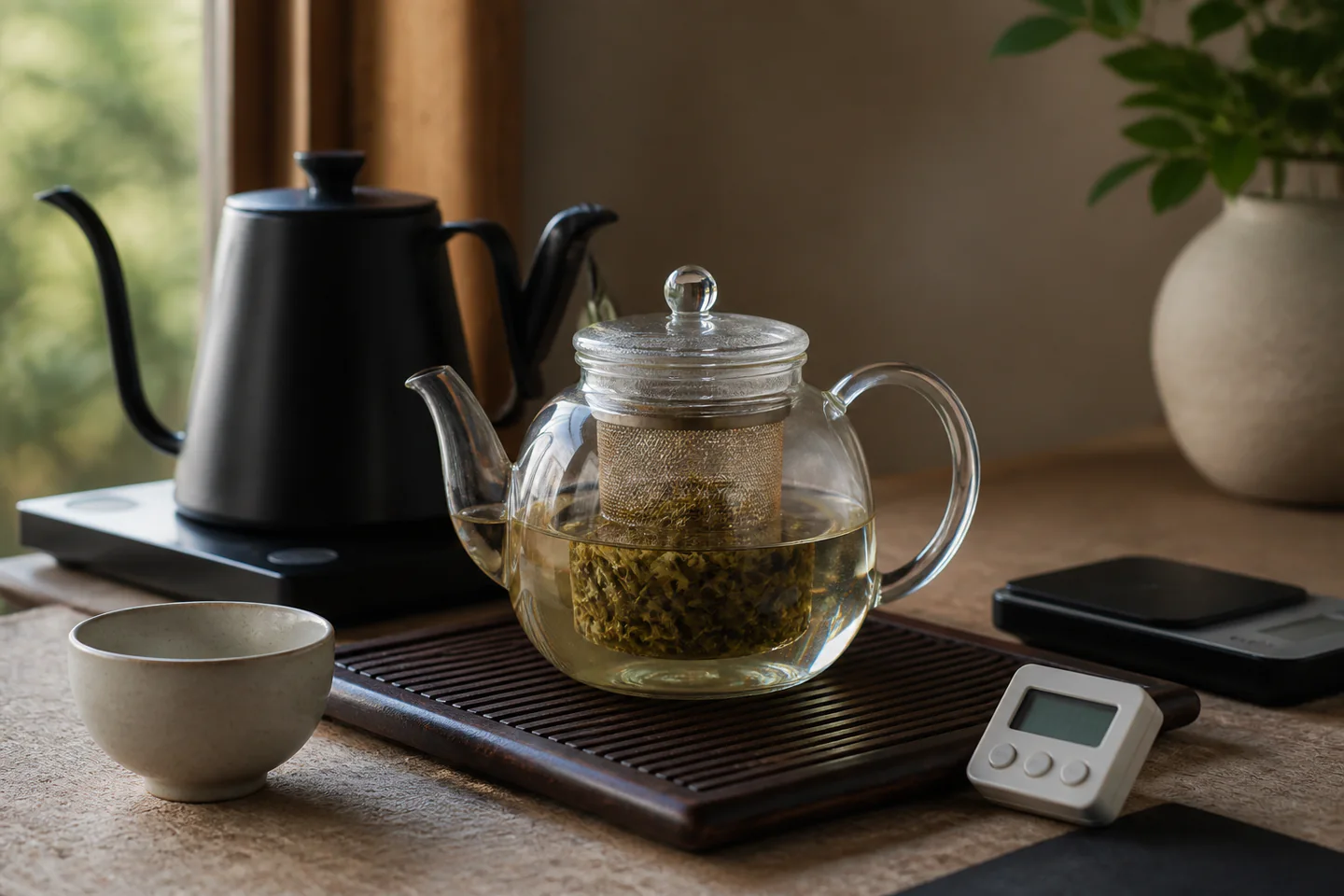
A basket infuser, scale or measured spoon and suitable water are enough. Start with one tea, then adjust temperature, leaf quantity and time separately.
Quick answer
Start with one tea and a roomy infuser
Use the seller’s leaf-to-water and temperature guidance, give leaves room in a basket, time the infusion, remove all leaves cleanly and taste before changing one variable.
- 01
Use fresh water, a clean cup and dry accurately stored leaves. Keep the first attempt narrow enough that preparation, the main action and the result can all be reviewed together.
- 02
Keep leaf mass and water volume fixed while temperature or time changes. Keep the first attempt narrow enough that preparation, the main action and the result can all be reviewed together.
- 03
Bitterness, astringency, thinness and aroma point to different adjustments. Keep the first attempt narrow enough that preparation, the main action and the result can all be reviewed together.
- 04
Do not judge every green, oolong and black tea by one boiling-water recipe. Keep the first attempt narrow enough that preparation, the main action and the result can all be reviewed together.
What to expect
Tea type changes the useful brewing window
Leaf size, processing and age affect extraction, so package guidance is a starting point rather than a permanent law.
The first attempt
A basket infuser is easier to empty and gives more room than a tiny novelty ball. For loose-leaf tea brewing, note what actually happened rather than relying on memory; that turns the next attempt into a controlled change instead of another guess.
What changes
Hotter or longer brewing usually extracts faster, including desirable flavour and harsh compounds. For loose-leaf tea brewing, note what actually happened rather than relying on memory; that turns the next attempt into a controlled change instead of another guess.
The useful signal
Aromatic but balanced liquor matters more than maximum colour. For loose-leaf tea brewing, note what actually happened rather than relying on memory; that turns the next attempt into a controlled change instead of another guess.
The common trap
Adding more leaf and more time together hides which change caused bitterness. For loose-leaf tea brewing, note what actually happened rather than relying on memory; that turns the next attempt into a controlled change instead of another guess.
Core method
Treat the cup as a small controlled extraction
Prepare deliberately
Use fresh water, a clean cup and dry accurately stored leaves. For loose-leaf tea brewing, note what actually happened rather than relying on memory; that turns the next attempt into a controlled change instead of another guess.
Control the central variable
Keep leaf mass and water volume fixed while temperature or time changes. For loose-leaf tea brewing, note what actually happened rather than relying on memory; that turns the next attempt into a controlled change instead of another guess.
Read the result
Bitterness, astringency, thinness and aroma point to different adjustments. For loose-leaf tea brewing, note what actually happened rather than relying on memory; that turns the next attempt into a controlled change instead of another guess.
Reset before repeating
Empty and rinse the infuser, note the recipe and choose one temperature or time change. For loose-leaf tea brewing, note what actually happened rather than relying on memory; that turns the next attempt into a controlled change instead of another guess.
Useful products
Products with a clear role
The shortlist covers the first workable route and one realistic improvement. Each exact Amazon UK page or ISBN was checked; confirm the current seller, specification, edition and availability.
HAUSPROFI Stainless Steel Basket Tea Infuser with Lid
It fits ordinary mugs and separates brewing from serving.
VAHDAM Top 10 Loose-Leaf Tea Sampler
Small packs help explore processing styles with less stale surplus.
Lawei Six Mini Double-Lid Tea Tins, 50 g
Separate tins reduce aroma transfer and oversized open bags.
First project
Brew one tea at three times
Keep water, leaf and temperature fixed, then compare slightly shorter and longer steeps.
- 01
Set up
Use fresh water, a clean cup and dry accurately stored leaves. For loose-leaf tea brewing, note what actually happened rather than relying on memory; that turns the next attempt into a controlled change instead of another guess.
- 02
Begin
Use the seller’s leaf-to-water and temperature guidance, give leaves room in a basket, time the infusion, remove all leaves cleanly and taste before changing one variable. For loose-leaf tea brewing, note what actually happened rather than relying on memory; that turns the next attempt into a controlled change instead of another guess.
- 03
Stay with one method
Keep leaf mass and water volume fixed while temperature or time changes. For loose-leaf tea brewing, note what actually happened rather than relying on memory; that turns the next attempt into a controlled change instead of another guess.
- 04
Finish and assess
Bitterness, astringency, thinness and aroma point to different adjustments. For loose-leaf tea brewing, note what actually happened rather than relying on memory; that turns the next attempt into a controlled change instead of another guess.
- 05
Record the next change
Empty and rinse the infuser, note the recipe and choose one temperature or time change. For loose-leaf tea brewing, note what actually happened rather than relying on memory; that turns the next attempt into a controlled change instead of another guess.
What can wait
What can wait until the method works
Buying around an unclear problem adds clutter. These upgrades make more sense after the first result exposes a repeatable limitation.
- 01
More capacity
Larger or multiple batches multiply matching temperature and time to tea before the small version is stable. For loose-leaf tea brewing, note what actually happened rather than relying on memory; that turns the next attempt into a controlled change instead of another guess.
- 02
Premium equipment
A variable-temperature kettle is convenient, but a basic kettle and cooling time can begin. For loose-leaf tea brewing, note what actually happened rather than relying on memory; that turns the next attempt into a controlled change instead of another guess.
- 03
Extra varieties
Do not open ten full bags before learning how quickly tea goes stale. For loose-leaf tea brewing, note what actually happened rather than relying on memory; that turns the next attempt into a controlled change instead of another guess.
- 04
Public or commercial claims
Tea preferences are sensory; avoid turning them into unsupported health promises. For loose-leaf tea brewing, note what actually happened rather than relying on memory; that turns the next attempt into a controlled change instead of another guess.
Upgrade path
Upgrade the repeated limitation
Improve temperature repeatability or storage after the first comparisons.
Try it
£15–£45Basket infuser and one fresh tea
Leaves expand and timing becomes visible.Repeat it
£15–£50Scale and thermometer or variable kettle
Recipes transfer between cups.Improve the bottleneck
£20–£80Small airtight tins and tasting cups
Comparisons become cleaner.Go deeper
VariableGongfu vessel and repeated short infusions
The same leaves reveal a changing sequence.Safety & care
Protect against scalding and stale storage
Tea equipment is low risk, but boiling water and wet electrical surfaces still matter.
- Use a stable cup and do not overfill the infuser vessel. Follow current manufacturer, food-safety, access, wildlife or local guidance wherever it applies.
- Keep kettle leads and bases dry. Follow current manufacturer, food-safety, access, wildlife or local guidance wherever it applies.
- Allow metal baskets to cool before handling. Follow current manufacturer, food-safety, access, wildlife or local guidance wherever it applies.
- Store leaves dry and discard musty or contaminated tea. Follow current manufacturer, food-safety, access, wildlife or local guidance wherever it applies.
- Check caffeine and medical advice where relevant. Follow current manufacturer, food-safety, access, wildlife or local guidance wherever it applies.
Outside help
When outside help earns its place
A specialist tasting is useful for comparing processing styles, but not required for daily brewing.
Use one complete lesson that covers preparation, the central technique, common mistakes and finishing. For a first loose-leaf tea brewing attempt, one coherent method is easier to diagnose than fragments collected from several creators.
Outside help earns its place when safe setup, access, identification or live correction removes a real obstacle. Ask what equipment, materials, access and follow-up support are included before booking.
Representative UK learning options checked 31 August 2026; local prices, access, materials and tutor support vary.
Sources
Where the guidance came from
The method is grounded in specialist, manufacturer and public guidance, then checked against recurring beginner problems and the exact products linked here.
-
01
UK Tea & Infusions Association · Tea
UK tea preparation and industry context.
Open source -
02
Tea Epicure · Brewing
Specialist brewing and sensory reference.
Open source -
03
World Tea Academy
Structured tea education context.
Open source -
04
VAHDAM · Brewing guides
Supplier guidance for listed sampler styles.
Open source -
05
r/tea
Community equipment and brewing comparisons.
Open source -
06
Amazon UK · Stainless Steel Basket Tea Infuser with Lid
Exact Amazon UK product page or ISBN used for the recommendation; current price, seller, specification and availability should be confirmed.
Open source -
07
Amazon UK · Top 10 Loose-Leaf Tea Sampler
Exact Amazon UK product page or ISBN used for the recommendation; current price, seller, specification and availability should be confirmed.
Open source -
08
Amazon UK · Six Mini Double-Lid Tea Tins, 50 g
Exact Amazon UK product page or ISBN used for the recommendation; current price, seller, specification and availability should be confirmed.
Open source
Guide information and links checked 31 August 2026.