Beginner’s guide · Write & create
Build letters from strokes,
not from a copied alphabet.
A firm small-tip brush pen and smooth paper are enough. Practise light upstrokes and heavier downstrokes separately, then combine them into one short word.
Quick answer
Practise pressure before the alphabet
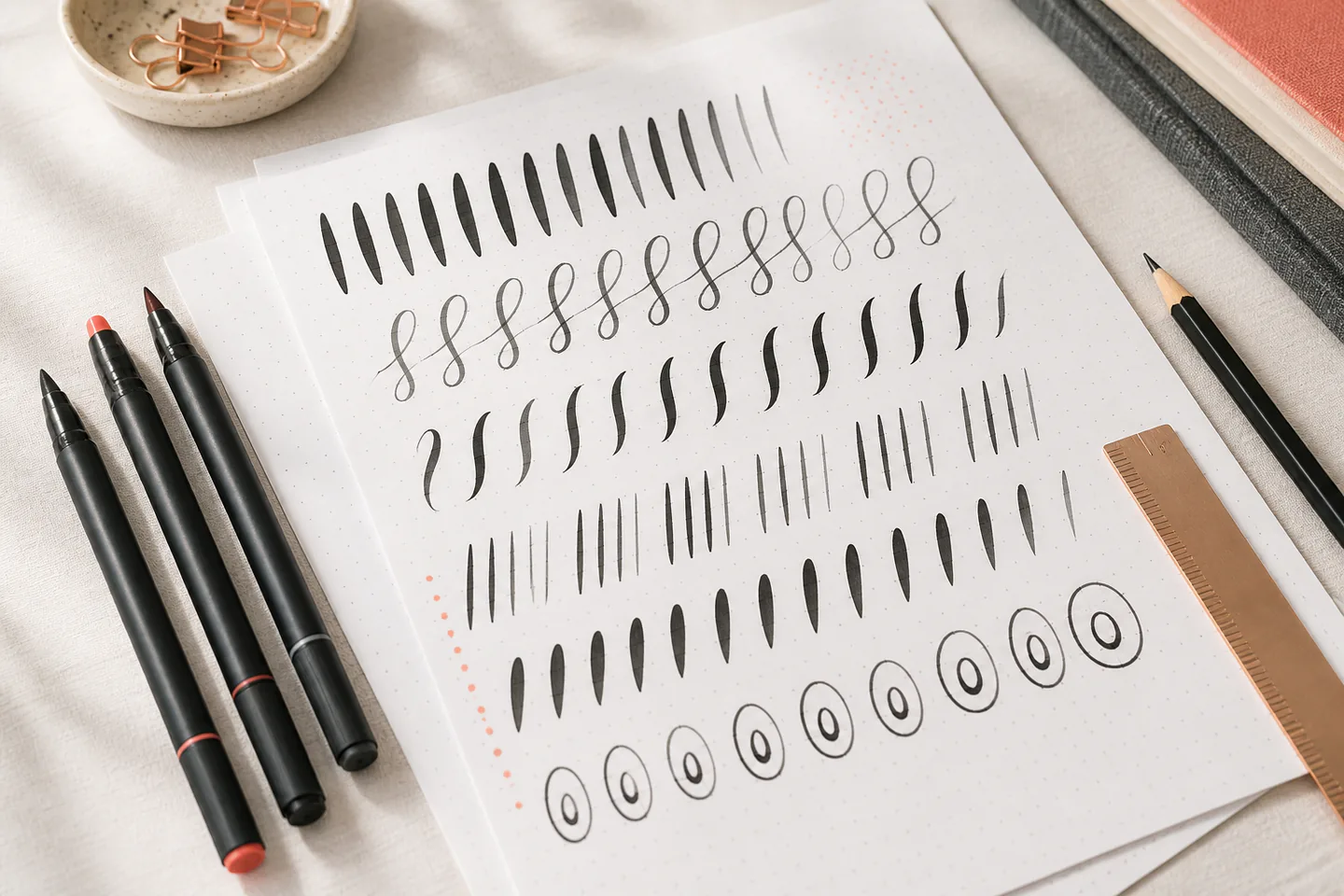
Use a dark firm-tipped brush pen on smooth paper. Fill one short row each with light upstrokes, heavier downstrokes, underturns, overturns and ovals, lifting between strokes; then construct one lowercase word from those same movements.
- 01
A thick downstroke comes from controlled pressure, while a thin upstroke needs a light touch. Keep the first attempt narrow enough that preparation, the main action and the result can all be reviewed together.
- 02
Letters are assembled from repeatable strokes; ordinary joined handwriting habits do not automatically transfer. Keep the first attempt narrow enough that preparation, the main action and the result can all be reviewed together.
- 03
Smooth paper protects felt tips from early fraying. Keep the first attempt narrow enough that preparation, the main action and the result can all be reviewed together.
- 04
Large flexible brush pens need more arm movement and are not automatically easier for a beginner. Keep the first attempt narrow enough that preparation, the main action and the result can all be reviewed together.
What to expect
Consistency arrives before style
Early strokes wobble because pressure, angle and speed are changing at once. Short drills isolate those variables.
Tip
A firm small tip gives clearer feedback and suits compact practice. For brush lettering, note what actually happened rather than relying on memory; that turns the next attempt into a controlled change instead of another guess.
Paper
Rough or absorbent paper can feather ink and wear the point. For brush lettering, note what actually happened rather than relying on memory; that turns the next attempt into a controlled change instead of another guess.
Rhythm
Lifting between strokes is normal and helps reset grip and angle. For brush lettering, note what actually happened rather than relying on memory; that turns the next attempt into a controlled change instead of another guess.
Spacing
Equal internal spaces matter as much as matching the outside silhouette. For brush lettering, note what actually happened rather than relying on memory; that turns the next attempt into a controlled change instead of another guess.
Core method
Turn pressure changes into repeatable components
Set guides and posture
Use a baseline, waist line and slant guide; support the forearm and keep the page at a comfortable angle. For brush lettering, note what actually happened rather than relying on memory; that turns the next attempt into a controlled change instead of another guess.
Calibrate the pen
Make parallel light and heavy lines without trying to form letters. For brush lettering, note what actually happened rather than relying on memory; that turns the next attempt into a controlled change instead of another guess.
Drill the basic families
Repeat ovals, underturns, overturns and compound curves slowly. For brush lettering, note what actually happened rather than relying on memory; that turns the next attempt into a controlled change instead of another guess.
Assemble and review
Build one word stroke by stroke, then mark the least consistent join for the next page. For brush lettering, note what actually happened rather than relying on memory; that turns the next attempt into a controlled change instead of another guess.
Useful products
Products with a clear job in the setup
The Tombow brush pen supplies the flexible writing point, the Rhodia pad supplies a smoother practice surface and the Micron set is only for later monoline layout or outlines.
Tombow ABT Dual Brush Pen, Black
One black pen is enough to learn pressure before colour sets.
Rhodia A4 Dot Pad
The dots support height, slant and spacing while the smooth surface is kind to tips.
Sakura Pigma Micron Fineliner Pens, Set of 6
Different widths separate rough construction, final contour and notes.
First project
Letter one short word in three stages
Use a five-letter word with several repeated curves so improvement is visible.
- 01
Draw guides
Mark baseline, waist line and a light slant. For brush lettering, note what actually happened rather than relying on memory; that turns the next attempt into a controlled change instead of another guess.
- 02
Warm up
Make five rows of basic strokes. For brush lettering, note what actually happened rather than relying on memory; that turns the next attempt into a controlled change instead of another guess.
- 03
Pencil the spacing
Place faint letter skeletons without decorative flourishes. For brush lettering, note what actually happened rather than relying on memory; that turns the next attempt into a controlled change instead of another guess.
- 04
Build the strokes
Lift and reset between each component. For brush lettering, note what actually happened rather than relying on memory; that turns the next attempt into a controlled change instead of another guess.
- 05
Compare three versions
Circle the most even example and note one pressure problem. For brush lettering, note what actually happened rather than relying on memory; that turns the next attempt into a controlled change instead of another guess.
What can wait
What can wait until the first result
Extra equipment becomes useful only when the basic method has exposed a specific, repeated limitation.
- 01
A hundred-colour set
Colour cannot correct uneven pressure or spacing. For brush lettering, note what actually happened rather than relying on memory; that turns the next attempt into a controlled change instead of another guess.
- 02
Flourishes
They amplify weak entry and exit control. For brush lettering, note what actually happened rather than relying on memory; that turns the next attempt into a controlled change instead of another guess.
- 03
Very rough art paper
It shortens felt-tip life and changes ink edges. For brush lettering, note what actually happened rather than relying on memory; that turns the next attempt into a controlled change instead of another guess.
- 04
A personal alphabet
Style becomes useful after the basic forms repeat reliably. For brush lettering, note what actually happened rather than relying on memory; that turns the next attempt into a controlled change instead of another guess.
Upgrade path
Upgrade the repeated limitation
Change tip size, colour or layout only when the basic stroke is stable.
Pencil simulation
FreeSoft pencil and pressure drills
Understand thick and thin without consuming ink.Small brush pen
£3–£12Firm tip and smooth paper
Control compact letters.Large brush pen
£3–£20Flexible tip and larger guides
Create bolder words and headings.Finished pieces
£15–£60Chosen paper, colour tests and layout tools
Turn practice into cards or artwork.Safety & care
Protect hands, posture and other people’s lettering
The hobby is low risk, but repetitive grip and unlicensed copying still deserve attention.
- Keep the grip light and take breaks when fingers, wrist or shoulder tire. Follow current manufacturer, food-safety, access, wildlife or local guidance wherever it applies.
- Use ventilated space and follow ink or marker labels. Follow current manufacturer, food-safety, access, wildlife or local guidance wherever it applies.
- Cap pens promptly and protect tables and clothing from water-based ink. Follow current manufacturer, food-safety, access, wildlife or local guidance wherever it applies.
- Credit sources and do not sell copied alphabets, worksheets or traced artwork without permission. Follow current manufacturer, food-safety, access, wildlife or local guidance wherever it applies.
- Keep small caps and art materials away from young children and pets. Follow current manufacturer, food-safety, access, wildlife or local guidance wherever it applies.
Outside help
When outside help earns its place
A short class is useful for live pressure correction, but a single coherent worksheet can guide the first week.
Use one complete basic-stroke sequence at the correct scale for the pen.
Check that materials, basic strokes and individual feedback are included.
Representative UK learning options checked 31 August 2026; local prices, access, materials and tutor support vary.
Sources
Where the guidance came from
Manufacturer worksheets and specialist teachers agree on pressure drills, basic strokes and suitable smooth paper before decorative alphabets.
-
01
Tombow · Beginner Dual Brush Lettering Handouts
Manufacturer stroke drills and pen technique.
Open source -
02
Tombow UK · ABT Dual Brush Pen
Current pen range and intended uses.
Open source -
03
Lettering Daily · Brush lettering for beginners
Structured basic-stroke and letter guidance.
Open source -
04
Loveleigh Loops · Brush pen lettering
Beginner method based on stroke construction.
Open source -
05
Reddit · r/BrushCalligraphy
Recurring beginner discussion of tips, paper and pressure.
Open source -
06
Amazon UK · ABT Dual Brush Pen, Black
Exact Amazon UK product page or ISBN used for the recommendation; current price, seller, specification and availability should be confirmed.
Open source -
07
Amazon UK · A4 Dot Pad
Exact Amazon UK product page or ISBN used for the recommendation; current price, seller, specification and availability should be confirmed.
Open source -
08
Amazon UK · Pigma Micron Fineliner Pens, Set of 6
Exact Amazon UK product page or ISBN used for the recommendation; current price, seller, specification and availability should be confirmed.
Open source
Guide information and links checked 31 August 2026.