Beginner’s guide · Grow & care
Let autumn leaves
become a quiet soil improver.
Leaf mould is made mainly by fungi from fallen deciduous leaves. Collect a clean mixed load, contain it with air and moisture, then wait a year or longer rather than treating it like fast garden compost.
Quick answer
Contain damp leaves and mark the date
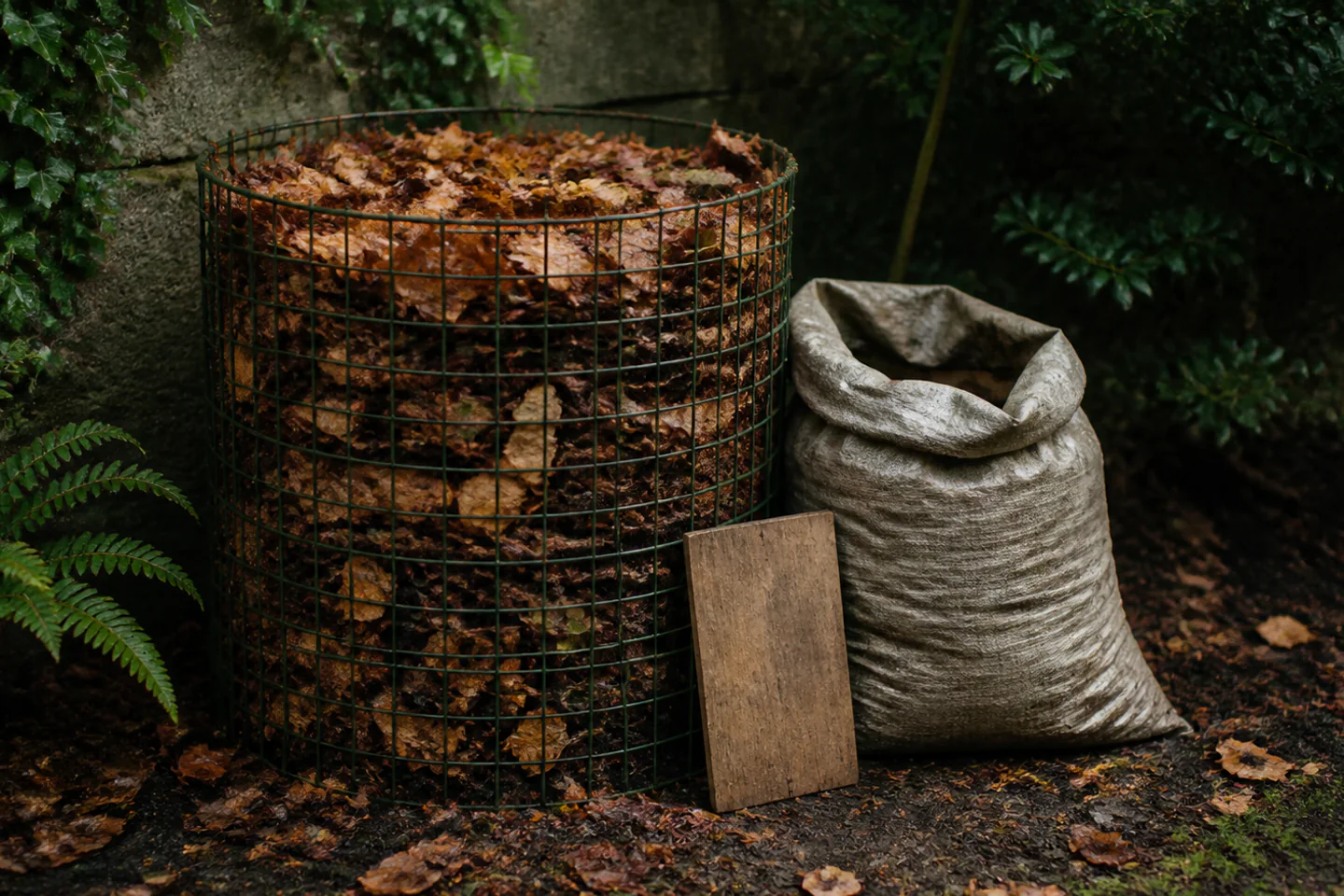
Collect clean fallen deciduous leaves, shred them if practical, wet until evenly damp and contain them in a wire cage or perforated bag. Label the batch and leave it for at least a year, checking only that it has not dried completely.
- 01
Use ordinary deciduous leaves and keep litter, dog waste and roadside contamination out of the batch. Record the setting, measurement or observation that mattered so the next attempt can be changed for a reason rather than by guesswork.
- 02
Shred thick or large leaves to speed fungal access, but avoid turning the job into a machinery requirement. Record the setting, measurement or observation that mattered so the next attempt can be changed for a reason rather than by guesswork.
- 03
Keep the mass damp and aerated rather than sealed in a waterlogged sack. Record the setting, measurement or observation that mattered so the next attempt can be changed for a reason rather than by guesswork.
- 04
Store the batch where a long wait will not block paths or offend neighbours. Record the setting, measurement or observation that mattered so the next attempt can be changed for a reason rather than by guesswork.
- 05
Judge maturity from dark crumbly texture and recognisability, then match the product to mulch or mix use. Record the setting, measurement or observation that mattered so the next attempt can be changed for a reason rather than by guesswork.
What to expect
Leaf mould follows a fungal timetable
Unlike a mixed hot compost heap, a leaf-only batch is carbon rich and normally cool, so patience is part of the method.
Leaf type
Thin leaves such as birch break down faster than leathery or waxy leaves. Very tough evergreen leaves may be better shredded and composted separately. In leaf-mould making, this is worth checking before the next stage because a small adjustment now is easier than undoing a finished result.
Time
One-year material can work as mulch; finer two-year leaf mould may suit seed or potting blends when properly screened and combined. In leaf-mould making, this is worth checking before the next stage because a small adjustment now is easier than undoing a finished result.
Moisture
A loose exposed cage can dry while a sealed bag can become anaerobic. Perforation and occasional checks maintain the middle ground. In leaf-mould making, this is worth checking before the next stage because a small adjustment now is easier than undoing a finished result.
Volume
A towering loose pile collapses dramatically. Collect more leaves than the desired finished volume suggests. In leaf-mould making, this is worth checking before the next stage because a small adjustment now is easier than undoing a finished result.
Core method
Collect clean material and leave good conditions
Choose the leaves
Gather fallen deciduous foliage from a low-contamination area and exclude litter, diseased material requiring special handling and unknown chemical residues. In leaf-mould making, this is worth checking before the next stage because a small adjustment now is easier than undoing a finished result.
Reduce size
Run a mower over a shallow layer or crush leaves in manageable quantities where safe, without pulverising stones or waste. In leaf-mould making, this is worth checking before the next stage because a small adjustment now is easier than undoing a finished result.
Contain and dampen
Fill a wire cage or punctured heavy-duty bag, watering lightly as dry layers are added and leaving air routes. In leaf-mould making, this is worth checking before the next stage because a small adjustment now is easier than undoing a finished result.
Label and wait
Record the autumn year, inspect after dry periods and screen only when the material has become dark, soft and earthy. In leaf-mould making, this is worth checking before the next stage because a small adjustment now is easier than undoing a finished result.
Useful products
Products with a clear job in the setup
An ordinary garden composter can hold leaves if it is not needed for mixed compost. The second bin shows a larger volume; the garden knife is for later controlled use, not for processing leaves.
Invopak 220 L Recycled Plastic Garden Composter
An enclosed ventilated bin is tidier where a wire cage is impractical.
4smile 300 Litre Garden Composter Bin
More leaves give a useful finished quantity after the large collapse in volume.
Nisaku NJP650 Hori-Hori Weeding and Digging Knife
A narrow tool disturbs less surrounding soil than a full spade for small jobs.
First project
Make one dated autumn batch
A labelled batch prevents next year’s fresh leaves from being confused with material close to maturity.
- 01
Choose a clean collection
Gather leaves from a safe area after fall, removing plastic, stones, pet waste and unsuitable evergreen material. In leaf-mould making, this is worth checking before the next stage because a small adjustment now is easier than undoing a finished result.
- 02
Shred if practical
Use a mower only on a checked shallow layer or crush leaves manually; leave them whole if safe shredding is inconvenient. In leaf-mould making, this is worth checking before the next stage because a small adjustment now is easier than undoing a finished result.
- 03
Wet and contain
Pack leaves loosely, adding water to dry layers and ensuring a bag has numerous ventilation holes. In leaf-mould making, this is worth checking before the next stage because a small adjustment now is easier than undoing a finished result.
- 04
Label and site
Write the collection month and year and keep the container shaded, stable and accessible for a moisture check. In leaf-mould making, this is worth checking before the next stage because a small adjustment now is easier than undoing a finished result.
- 05
Assess after a year
Use coarse dark material as mulch or leave it longer for a finer result; return recognisable tough pieces to the next batch. In leaf-mould making, this is worth checking before the next stage because a small adjustment now is easier than undoing a finished result.
What can wait
What can wait until the first result
The batch needs leaves, moisture, air and time—not accelerators or weekly turning.
- 01
Nitrogen accelerators
Adding grass or food changes the material toward mixed compost. Keep the first leaf-mould batch simple. In leaf-mould making, this is worth checking before the next stage because a small adjustment now is easier than undoing a finished result.
- 02
Frequent turning
It is unnecessary for a loose aerated leaf batch and makes a slow low-maintenance process more burdensome. In leaf-mould making, this is worth checking before the next stage because a small adjustment now is easier than undoing a finished result.
- 03
Using immature leaves in seed mix
Recognisable, unstable material can behave unpredictably in small pots; use it as surface mulch or wait longer. In leaf-mould making, this is worth checking before the next stage because a small adjustment now is easier than undoing a finished result.
Upgrade path
Upgrade the repeated limitation
Increase capacity only after the first batch has a planned garden use.
Try it
£10–£65Ventilated bag, wire cage or spare composter
The local leaves and their decomposition speed become known.Shred safely
£20–£150Mower collection or suitable shredder workflow
Tough leaves break down faster when the collection justifies the effort.Run yearly bays
£40–£150Two labelled cages or bins
Fresh and maturing years remain separate.Blend carefully
VariableScreen and documented peat-free potting components
Fine mature material can support specific mixes after its behaviour is understood.Safety & care
Collect lawfully and avoid contaminated material
Leaves are habitat and public material as well as a resource, so collection location and handling matter.
- Collect only where you have permission and do not strip woodland litter or remove habitat from sensitive areas. Follow current manufacturer, food-safety, electrical or local guidance wherever it applies.
- Exclude leaves contaminated by traffic, chemicals, pet waste or litter when the finished material will be used around food crops. Follow current manufacturer, food-safety, electrical or local guidance wherever it applies.
- Inspect a leaf layer for stones, metal and wildlife before using a mower or shredder. Follow current manufacturer, food-safety, electrical or local guidance wherever it applies.
- Wear gloves, avoid breathing dry mould and stop if the material aggravates respiratory or allergy symptoms. Follow current manufacturer, food-safety, electrical or local guidance wherever it applies.
Outside help
When outside help earns its place
A community composting demonstration can show mature leaf mould and local uses. The first batch otherwise needs only a clear method and patience.
Use one complete lesson that covers preparation, the main technique, troubleshooting and finishing. For a first leaf-mould making project, following one coherent method is more useful than combining partial instructions from several creators.
Outside help earns its place when safe setup, equipment access or live correction would remove a real obstacle. Ask what materials, supervision and take-home result are included before booking.
Representative UK learning options checked 30 August 2026; local prices, access, materials and tutor support vary.
Sources
Where the guidance came from
The method is grounded in specialist, manufacturer and public guidance, then checked against recurring beginner problems and the exact products linked here.
-
01
Royal Horticultural Society · Leaf mould
UK guidance on suitable leaves, methods and uses.
Open source -
02
Garden Organic · Leaf mould
Organic gardening guidance for leaf-only decomposition.
Open source -
03
Woodland Trust · Fallen leaves
Habitat context and responsible leaf handling.
Open source -
04
Recycle Now · Garden waste
UK garden-waste route context.
Open source -
05
Royal Horticultural Society · Mulches
Use of mature organic material as mulch.
Open source -
06
Amazon UK · 220 L Recycled Plastic Garden Composter
Exact Amazon UK product page or ISBN used for the recommendation; current price, seller, specification and availability should be confirmed.
Open source -
07
Amazon UK · 300 Litre Garden Composter Bin
Exact Amazon UK product page or ISBN used for the recommendation; current price, seller, specification and availability should be confirmed.
Open source -
08
Amazon UK · NJP650 Hori-Hori Weeding and Digging Knife
Exact Amazon UK product page or ISBN used for the recommendation; current price, seller, specification and availability should be confirmed.
Open source
Guide information and links checked 30 August 2026.