Beginner's guide · Cook & bake
Cook one small batch.
Refrigerate the first jars.
Start with a tested small-batch fruit recipe and treat the result as refrigerator jam. You can learn fruit preparation, a rolling boil and setting point before adding shelf-stable processing.
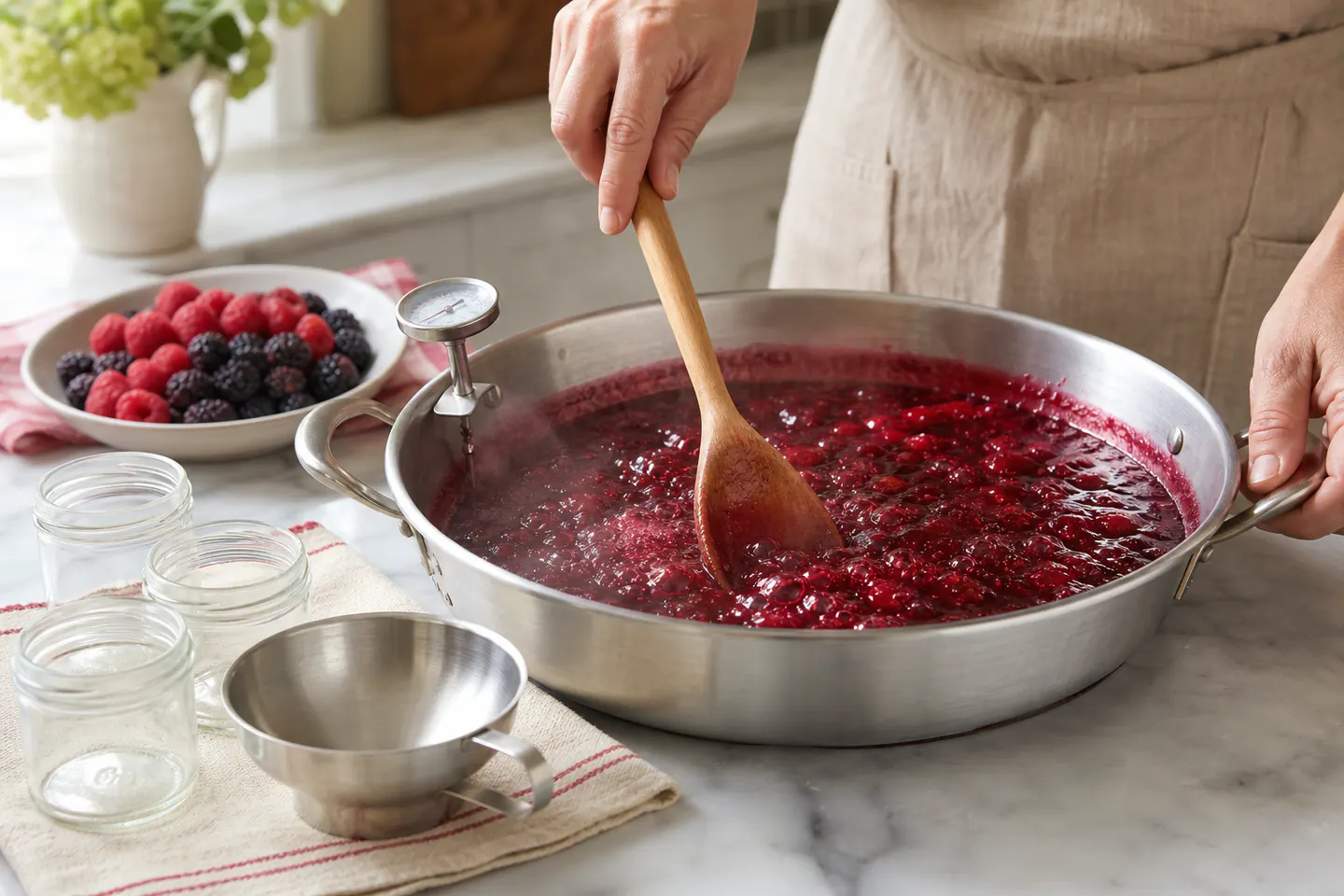
Quick answer
Cook one small batch.
Choose a current tested strawberry or raspberry jam recipe, read it completely, weigh every ingredient and prepare clean heat-safe jars before the fruit reaches a boil. For the first attempt, cool the filled jars safely, refrigerate them and follow the recipe's refrigerated storage time.
- 01
Do not freestyle sugar, acid, pectin type or batch size. Those variables affect set and, in a shelf-stable recipe, the validated preserving process.
- 02
A broad heavy pan leaves headroom for the rapid foamy boil. A dedicated maslin pan is convenient, but a suitable large saucepan already owned can work.
- 03
A sugar thermometer gives an objective reference; the wrinkle or flake test confirms the gel behaviour. Use the method specified by the tested recipe.
- 04
For room-temperature storage, follow a validated recipe and its complete boiling-water processing instructions, including jar type, headspace, time and altitude adjustments.
What to expect
What the first attempts really involve
The first project is useful because it exposes the decisions that shopping pages tend to hide.
Fruit
Ripeness changes pectin, acidity and water. Weigh prepared fruit exactly and do not assume a sweeter berry needs less recipe sugar.
Boil
Jam rises quickly and spits sticky syrup. A deep pan, long utensil and fully prepared filling area prevent a rushed hot transfer.
Set
Hot jam looks loose. It continues to thicken as it cools, so repeated boiling to make it look finished in the pan can produce a rubbery set.
Pectin
Liquid and powdered pectin are not interchangeable and are added at different stages. Follow the exact product and recipe directions.
Storage
A vacuum-looking lid is not proof of a validated shelf-stable process. Refrigerated jam and processed pantry jam are separate routes.
Choose the route
Separate jam cooking from shelf-stable canning
Route one: learn the gel in the refrigerator
A tested small-batch recipe can be cooked, transferred to clean heat-safe jars, cooled and refrigerated without claiming pantry stability. This route keeps the first lesson on weighing fruit, dissolving sugar, reaching a rolling boil and recognising setting point. Label each jar with the date and use it within the recipe's refrigerated guidance.
Route two: preserve a tested formula
Room-temperature storage requires more than a hot jar and a lid that pulls down. Use a validated source such as the National Center for Home Food Preservation or an authoritative pectin manufacturer and follow its named jar size, headspace, lid, boiling-water process, time and altitude adjustment. Do not add herbs, reduce sugar or double a pectin batch unless that tested recipe permits it.
Prepare the landing area first
Hot jam cannot wait while a funnel is found. Set out jars, lids, ladle, funnel, heatproof mat, clean damp cloth and labels before turning up the heat. Keep children and pets out of the working route from hob to filling area.
Starter products
A controlled pan, a readable thermometer and a cleaner fill
The 4.5-litre maslin pan suits modest batches and induction hobs, the Tala thermometer gives a continuous sugar-stage reference and the Kilner funnel reduces rim spills. Existing suitable cookware can replace the pan, and the funnel does not replace the headspace in a tested preserving recipe.
KitchenCraft Home Made Maslin Pan, 4.5 Litres
The broad 4.5-litre body and pouring lip help control foamy boiling and transfer without committing to a very large preserving pan.
Tala Jam and Confectionery Thermometer
The pot clip keeps the probe in the syrup and makes it easier to notice the approach to the recipe's endpoint.
Kilner Stainless-Steel Easy-Fill Jam Funnel
The broad mouth leaves room for a ladle and the narrow stem directs jam away from the sealing rim.
First batch
Make a tested refrigerator jam
Select one current recipe from an authoritative source and keep every ingredient, quantity and step unchanged. The outline below is preparation guidance, not a replacement formula.
- 01
Read and choose the storage route
Confirm the recipe is intended for jam, note its yield and decide in advance that this first batch will be refrigerated.
- 02
Inspect and prepare jars
Use clean heat-safe jars without chips or cracks. Prepare them by the recipe or jar maker's current method and keep them protected from thermal shock.
- 03
Weigh the prepared fruit
Remove only what the recipe names, then weigh the usable fruit. Measure sugar, acid and the exact pectin separately.
- 04
Arrange the hot zone
Clip the thermometer correctly without touching the pan base, place tools within reach and clear the route to a heatproof filling area.
- 05
Cook exactly as directed
Dissolve and boil in the stated order. Stir with a long utensil, watch the headroom and never lean over rising foam.
- 06
Test the set once
Use the recipe's temperature, flake or chilled-plate method. Remove the pan from heat while testing so carry-on boiling does not overshoot.
- 07
Fill cleanly
Use the funnel and a heatproof ladle, wipe spills from the rim and close with the lid system as directed for refrigerated storage.
- 08
Cool, label and refrigerate
Leave space around hot jars, avoid retightening or tilting them and refrigerate when the recipe directs. Record fruit, recipe and date.
Troubleshooting
A failed set is usually still useful jam
Runny jam may need time
Let the batch cool fully and, where the recipe uses added pectin, allow the stated time for the gel to form. Do not repeatedly reopen and boil a sealed jar. Refrigerated loose jam works as a sauce or yoghurt topping while the cause is reviewed.
A stiff set usually means too much evaporation
An oversized batch, narrow pan, inaccurate thermometer or repeated set tests can change the endpoint. Record the pan, fruit weight, maximum temperature and cooking time. Reworking a stiff preserve for long-term storage is not automatically recommended; consult the authoritative recipe source.
Crystals point to sugar handling
Undissolved grains on the pan side, stirring at the wrong stage or formula changes can seed crystallisation. Follow the recipe's order and use clean utensils. Do not scrape crusted pan sides into the finished jam.
Skip for now
What can wait
The refrigerator route uses ordinary kitchen control. Shelf-stable processing tools belong to the next deliberate step, not an improvised extension.
- 01
A dedicated preserving pan
The selected 4.5-litre pan adds headroom and a pouring lip, but a large heavy saucepan is enough when it safely fits the tested batch.
- 02
A water-bath canner
Buy or assemble a purpose-appropriate system only after choosing tested shelf-stable recipes and checking jar clearance, rack and local guidance.
- 03
Large jar packs
Small jars cool, portion and gift more sensibly. Never substitute a larger jar than the tested process specifies.
- 04
Low-sugar experimentation
Use a recipe and pectin designed and tested for reduced sugar. Cutting sugar from a conventional formula changes both set and preservation.
- 05
Herbs, alcohol and mixed fruit
Flavour additions can affect a validated formula. Practise the base recipe, then choose a tested variation rather than improvising pantry storage.
Upgrade path
What a better setup changes
A better setup adds safe repeatability and shelf-stable processing; it does not license untested recipes.
Refrigerator batch
About £10–£50Large pan + scale + thermometer + clean jars
Learn fruit preparation, rolling boil, set and hot filling.Regular small batches
About £40–£100Maslin pan + funnel + jar lifter + batch notes
Improve headroom, handling and repeatability across known recipes.Shelf-stable tested jam
About £60–£180Suitable water bath + rack + approved jars and lids
Process validated high-acid preserves for pantry storage.Selling preserves
Business dependentRegistration + food-safety system + labels + insurance
Move from household hobby to regulated production and traceable batches.Safety
Work safely from the first attempt
Boiling jam sticks to skin and jars can fail under thermal shock. Storage safety depends on a validated recipe and process, not appearance.
- Keep skin covered, use long utensils and never lean over or move a pan of vigorously boiling jam unnecessarily.
- Use jars intended for the chosen heat process, reject chips or cracks and avoid sudden temperature changes.
- For shelf-stable jam, follow a tested recipe's jar size, headspace, water-bath time and altitude adjustment exactly.
- Do not taste from a jar with mould, fermentation, leakage, spurting contents or a failed seal; discard the whole contents using authoritative guidance.
- Label every jar with recipe and date, refrigerate opened jam and follow the validated source's storage instructions.
- Register with the local authority and implement food-safety procedures before selling food from home in the UK.
Classes
When outside help is useful
A class is optional for refrigerator jam. It becomes useful for safe water-bath processing, troubleshooting pectin or understanding the legal move from gifts to sales.
Use a complete source that includes storage and processing, not a short social clip showing only the boil.
Current UK sessions introduce jam, pickles and seasonal storage with shared equipment.
Worthwhile when jar handling, water-bath processing and multiple tested recipes are demonstrated hands-on.
Representative UK preserving workshops and 2026 prices checked 27 July 2026.
Sources
Sources and checking notes
UK sources support setting-point and jar preparation, while the National Center for Home Food Preservation supplies conservative tested processing and storage guidance. Community discussions reinforce recipe fidelity, small jars and proper jar-handling tools.
-
01
National Center for Home Food Preservation · Jam and jelly
Authoritative tested recipes, processing guidance and troubleshooting.
Open source -
02
National Center for Home Food Preservation · Recommended jars and lids
Jar inspection, size, filling and lid-system guidance.
Open source -
03
National Center for Home Food Preservation · Storing jams and jellies
Storage, spoilage and mould-discard guidance.
Open source -
04
Women's Institute · WI jam
UK jam method, jar preparation and flake-test description.
Open source -
05
Good Food · How to sterilise jars
UK timing and hot-jar preparation guidance.
Open source -
06
GOV.UK · Starting a food business
Registration and food-safety requirements before selling home-produced food.
Open source -
07
r/Canning · Beginner equipment
Recent practitioner advice on small jars, funnels, jar lifters and tested recipes.
Open source -
08
r/Canning · First big jam batch
Community warning that shelf-stable jam needs a tested recipe and hot, timely filling.
Open source -
09
PECT · Preserving workshop
Current 2026 UK community preserving session at £15.
Open source -
10
Amazon UK · KitchenCraft 4.5-litre maslin pan
Exact compact induction-compatible preserving pan.
Open source -
11
Amazon UK · Tala jam thermometer
Exact clip-on analogue jam and confectionery thermometer.
Open source -
12
Amazon UK · Kilner jam funnel
Exact stainless-steel wide-mouth filling funnel.
Open source
Guide information and links checked 27 July 2026.