Beginner’s guide · Make & create
Touch the water lightly,
and let the rings move before the paper does.
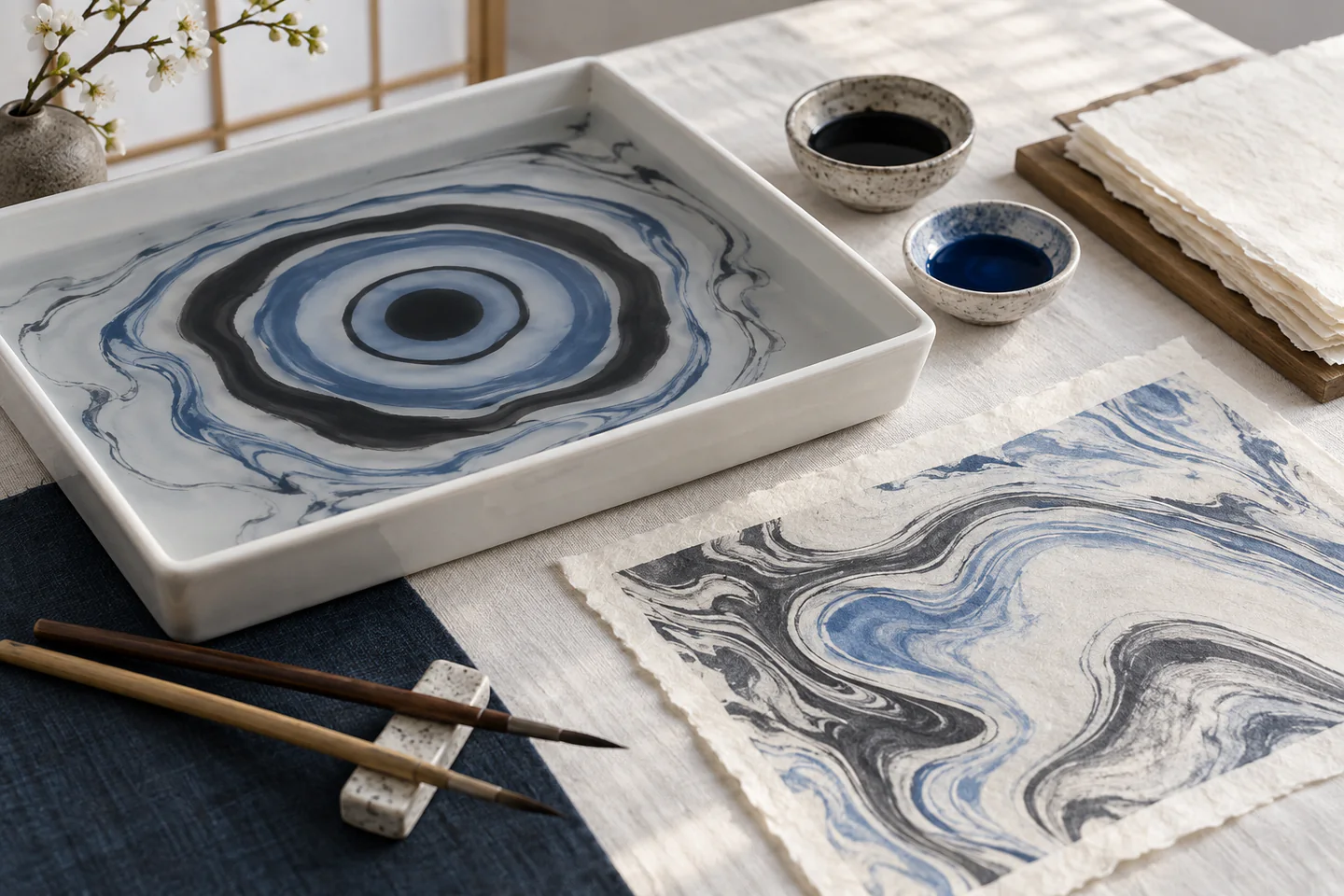
Suminagashi is Japanese floating-ink marbling built from expanding rings on water. Start with black ink and a few controlled prints.
Quick answer
Complete one three monochrome ring-pattern prints before expanding the setup
Fill a shallow clean tray with suitable water and prepare two brushes, one for black suminagashi ink and one for the dispersant method specified by the chosen source. Alternate the lightest possible touches at the surface to build rings, move the pattern with gentle breath or a fan only if desired and lower absorbent paper in one smooth action. Pull several prints before changing colour.
- 01
Suminagashi traditionally develops rings directly on water and differs from size-based Western marbling systems. For a first suminagashi attempt, keep the materials, measurements and sequence written beside the work. Photograph or measure the result before correcting it, because a visible record separates a technique problem from a material or setup problem.
- 02
Water chemistry, brush contamination and surfactant strength can determine whether ink floats or sinks. For a first suminagashi attempt, keep the materials, measurements and sequence written beside the work. Photograph or measure the result before correcting it, because a visible record separates a technique problem from a material or setup problem.
- 03
The pattern records tiny air movements, vibrations and paper contact, so a level still station matters. For a first suminagashi attempt, keep the materials, measurements and sequence written beside the work. Photograph or measure the result before correcting it, because a visible record separates a technique problem from a material or setup problem.
- 04
Each pull changes or removes the image; repetition means rebuilding rather than copying exactly. For a first suminagashi attempt, keep the materials, measurements and sequence written beside the work. Photograph or measure the result before correcting it, because a visible record separates a technique problem from a material or setup problem.
What to expect
What suminagashi is really like at the start
The useful beginner controls are setup, repeatable movement and a finished sample. Touching ink to the surface without sinking or overworking it is the main skill to observe before adding scale or decoration.
Water
Minerals, soap residue or a greasy tray can prevent reliable spreading. For a first suminagashi attempt, keep the materials, measurements and sequence written beside the work. Photograph or measure the result before correcting it, because a visible record separates a technique problem from a material or setup problem.
Touch
A submerged brush deposits a blob instead of a thin expanding ring. For a first suminagashi attempt, keep the materials, measurements and sequence written beside the work. Photograph or measure the result before correcting it, because a visible record separates a technique problem from a material or setup problem.
Air
Drafts and heavy blowing break concentric forms before the print is ready. For a first suminagashi attempt, keep the materials, measurements and sequence written beside the work. Photograph or measure the result before correcting it, because a visible record separates a technique problem from a material or setup problem.
Paper
Coated or non-absorbent sheets may lift little ink or smear during removal. For a first suminagashi attempt, keep the materials, measurements and sequence written beside the work. Photograph or measure the result before correcting it, because a visible record separates a technique problem from a material or setup problem.
Core method
The core suminagashi method
Clean and level the tray
Use dedicated grease-free tools and establish a shallow undisturbed water surface. For a first suminagashi attempt, keep the materials, measurements and sequence written beside the work. Photograph or measure the result before correcting it, because a visible record separates a technique problem from a material or setup problem.
Test ink and dispersant
Make a few alternating touches on scrap water and adjust only one variable. For a first suminagashi attempt, keep the materials, measurements and sequence written beside the work. Photograph or measure the result before correcting it, because a visible record separates a technique problem from a material or setup problem.
Build a restrained pattern
Create rings slowly, then use minimal air movement to shape rather than churn them. For a first suminagashi attempt, keep the materials, measurements and sequence written beside the work. Photograph or measure the result before correcting it, because a visible record separates a technique problem from a material or setup problem.
Lay and lift the paper
Place from one edge, avoid sliding, lift cleanly and dry flat before judging contrast. For a first suminagashi attempt, keep the materials, measurements and sequence written beside the work. Photograph or measure the result before correcting it, because a visible record separates a technique problem from a material or setup problem.
Useful products
Products with a clear job in the route
These two products cover distinct jobs in the beginner route; they are not a requirement to buy a bundle. Use materials already owned when they meet the same specification, and confirm every live listing before ordering.
House of Crafts Creative Marbling Kit
A matched kit reduces chemistry variables while floating and transfer are learned.
Canson XL Mix Media Pad, 11 × 14 inches
Sheets can be cut down for several controlled trials.
First project
Make three monochrome ring-pattern prints
Keep the project small enough to finish, inspect and repeat. The first result is evidence about material compatibility, sequence and control rather than a performance test.
- 01
Prepare the workspace and materials
Use dedicated grease-free tools and establish a shallow undisturbed water surface. For a first suminagashi attempt, keep the materials, measurements and sequence written beside the work. Photograph or measure the result before correcting it, because a visible record separates a technique problem from a material or setup problem.
- 02
Make the first controlled pass
Make a few alternating touches on scrap water and adjust only one variable. For a first suminagashi attempt, keep the materials, measurements and sequence written beside the work. Photograph or measure the result before correcting it, because a visible record separates a technique problem from a material or setup problem.
- 03
Check the central technique
Create rings slowly, then use minimal air movement to shape rather than churn them. For a first suminagashi attempt, keep the materials, measurements and sequence written beside the work. Photograph or measure the result before correcting it, because a visible record separates a technique problem from a material or setup problem.
- 04
Complete the structure
Place from one edge, avoid sliding, lift cleanly and dry flat before judging contrast. For a first suminagashi attempt, keep the materials, measurements and sequence written beside the work. Photograph or measure the result before correcting it, because a visible record separates a technique problem from a material or setup problem.
- 05
Finish, measure and record
Let the work settle or dry by the relevant material instructions, then measure, photograph and label the result. Record the one change that would make the next suminagashi attempt more controlled. For a first suminagashi attempt, keep the materials, measurements and sequence written beside the work. Photograph or measure the result before correcting it, because a visible record separates a technique problem from a material or setup problem.
What can wait
What can wait until the first result
Delay anything that adds cost, risk or another variable before the basic workflow has produced something you can review.
- 01
Many colours
Cross-contamination makes a basic spreading problem harder to diagnose. For a first suminagashi attempt, keep the materials, measurements and sequence written beside the work. Photograph or measure the result before correcting it, because a visible record separates a technique problem from a material or setup problem.
- 02
Thickened carrageenan bath
That belongs to a different marbling route. For a first suminagashi attempt, keep the materials, measurements and sequence written beside the work. Photograph or measure the result before correcting it, because a visible record separates a technique problem from a material or setup problem.
- 03
Large sheets
They trap air and disturb the surface during placement. For a first suminagashi attempt, keep the materials, measurements and sequence written beside the work. Photograph or measure the result before correcting it, because a visible record separates a technique problem from a material or setup problem.
- 04
Bookbinding immediately
First test whether ink is dry, stable and compatible with adhesive. For a first suminagashi attempt, keep the materials, measurements and sequence written beside the work. Photograph or measure the result before correcting it, because a visible record separates a technique problem from a material or setup problem.
Upgrade path
Add the capability you can now name
Each stage should remove a demonstrated limitation rather than make the setup look more advanced.
Monochrome pulls
Use owned tools where possibleOne small sample and written notes
Learn the central movement and material behaviour.Two-colour series
About £20–£80A repeatable complete starter setup
Repeat the result with cleaner finish and fewer corrections.Large controlled papers
About £50–£180A selected tool or structured class
Add one technique, size or design capability.Book or textile applications
Cost varies widelyA documented specialist workflow
Develop original work with provenance, testing and appropriate safety.Safety & care
Safety, care and respectful practice in suminagashi
The practical risks are manageable when tools, materials and cultural claims remain specific and proportionate.
- Keep ink, surfactant and rinse tools separate from food use. For a first suminagashi attempt, keep the materials, measurements and sequence written beside the work. Photograph or measure the result before correcting it, because a visible record separates a technique problem from a material or setup problem.
- Protect clothes and surfaces and follow every ink safety label. For a first suminagashi attempt, keep the materials, measurements and sequence written beside the work. Photograph or measure the result before correcting it, because a visible record separates a technique problem from a material or setup problem.
- Wipe water spills immediately to prevent slips and table damage. For a first suminagashi attempt, keep the materials, measurements and sequence written beside the work. Photograph or measure the result before correcting it, because a visible record separates a technique problem from a material or setup problem.
- Use good ventilation if any chosen material label requires it. For a first suminagashi attempt, keep the materials, measurements and sequence written beside the work. Photograph or measure the result before correcting it, because a visible record separates a technique problem from a material or setup problem.
- Credit Japanese sources and avoid treating all floating-colour methods as interchangeable. For a first suminagashi attempt, keep the materials, measurements and sequence written beside the work. Photograph or measure the result before correcting it, because a visible record separates a technique problem from a material or setup problem.
Outside help
When outside help earns its place
A guided session is useful when equipment setup, live hand correction, heat, sharp tools or a specialist press blocks safe progress. A clear source is enough for the smallest suminagashi sample.
Choose one coherent lesson that covers preparation, the central suminagashi technique, finishing and common mistakes.
Ask which tools and materials are included, whether the project can be finished in the session and what safety induction is provided.
Representative UK learning and access routes checked 20 September 2026; local prices, equipment and tutor support vary.
Sources
Where the guidance came from
Authoritative and specialist guidance supports the method, terminology and safety boundaries; community discussion contributes recurring beginner problems rather than unsupported claims.
-
01
The Met · Japanese marbled papers
Museum object and historical context.
Open source -
02
Victoria and Albert Museum · Japanese art
Japanese material-culture context.
Open source -
03
Colophon Book Arts · Suminagashi
Specialist material and technique context.
Open source -
04
Jacquard · Suminagashi
Manufacturer ink and method guidance.
Open source -
05
Guild of Book Workers
Book-arts practice and paper-handling context.
Open source -
06
Reddit · r/bookbinding
Community evidence on marbled-paper drying and later use.
Open source -
07
Amazon UK · Creative Marbling Kit
Exact Amazon UK catalogue page or ISBN used for the recommendation; confirm current price, seller, specification and availability.
Open source -
08
Amazon UK · XL Mix Media Pad, 11 × 14 inches
Exact Amazon UK catalogue page or ISBN used for the recommendation; confirm current price, seller, specification and availability.
Open source
Guide information and links checked 20 September 2026.