Beginner’s guide · Reflect & explore
Choose a clear picture,
sort before searching.
Begin with a high-contrast 300- or 500-piece puzzle whose sections look different. Good lighting and a simple sorting method matter more than maximum piece count.
Quick answer
Start with 500 pieces and several distinct colour regions
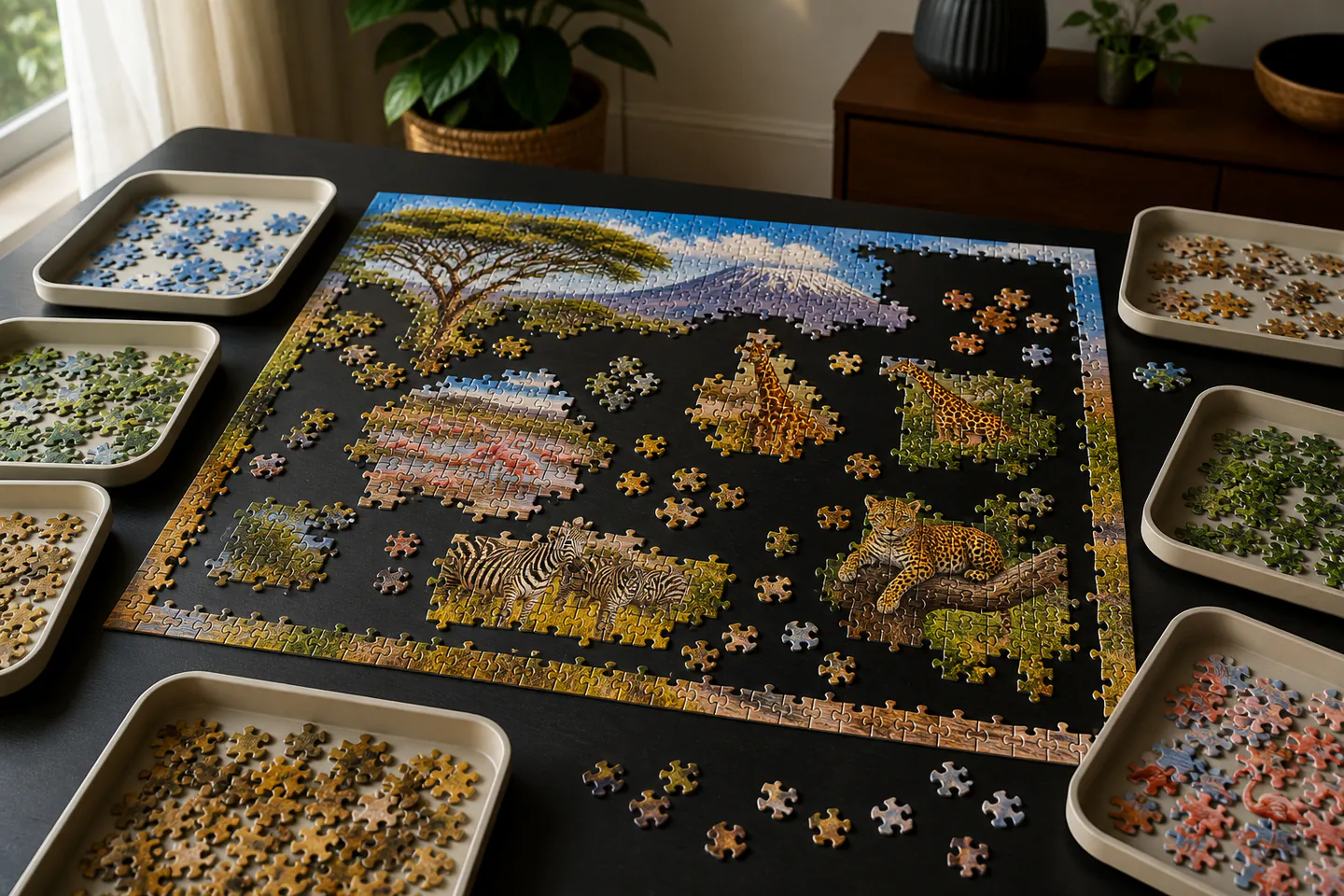
Choose a reputable 300- or 500-piece puzzle with a clear reference image, limited repeated texture and finished dimensions that fit the available table. Open it over a tray, turn every piece face-up and separate obvious edges plus two or three strong colour or object groups. Build a small recognisable section rather than scanning all pieces randomly, then connect it to the border when the image supports it. Never force a near-fit; rotate, compare tabs and gaps and return it to the candidate group.
- 01
Piece count is only one part of difficulty. Large areas of sky, grass, fur, gradient or repeated pattern can make 500 pieces harder than a varied 1,000.
- 02
Check finished dimensions and available table before buying. Box size does not show the footprint of the completed puzzle.
- 03
Turn all pieces face-up and create a few meaningful groups; too many tiny categories waste more time than they save.
- 04
A correct piece sits flat without force and matches image, cut and neighbouring gaps. Forcing damages both the piece and the search process.
- 05
Missing pieces are often in sleeves, under boxes, on the floor or mixed into another group. Maintain a contained opening and closing routine.
What to expect
The picture supplies the search terms
Experienced puzzlers are not testing every piece against every gap. They narrow candidates through colour transitions, line direction, texture, orientation and the exact combination of tabs and blanks.
Image
Distinct objects and colour boundaries create useful subprojects. Soft paintings and gradients provide fewer clues.
Cut
Some brands repeat shapes more than others. Learn the cut language of the current puzzle before assuming a false fit.
Border
Building the edge first gives a frame, but unusual or borderless designs may be easier by object.
Light
Glare hides print detail and strains the neck. Broad diffuse light is often more useful than a brighter ceiling bulb.
Storage
A board or trays preserve work between sessions, but the cheapest first solution may be a table that can remain undisturbed.
Pace
A stuck section is normal. Switching colour group or taking a break often restores visual discrimination.
Core method
Reduce the candidate pool before testing a piece
Choose a fair first image
Look for strong colour blocks, recognisable objects and a manufacturer that states completed dimensions. Avoid a photographic pile of identical sweets or a single-colour novelty for the first puzzle. Inspect accessibility needs such as piece size, contrast, dexterity and seated reach.
Open and inventory carefully
Use a clean floor and table area, open the inner bag over the box and keep the box image upright. Turn all pieces face-up in broad rows or trays. Separate obvious edge pieces but accept that unusual cuts can hide them until later.
Build searchable islands
Pick one unmistakable feature, gather its colours and look for lines that continue across pieces. Sort candidates by orientation and tab pattern only when the visual group is still large. Complete several small islands and use the reference image to position them.
Close the session
Count only if the manufacturer or puzzle format makes that practical, scan chair, clothes and floor and return loose groups to labelled trays. Cover the work or slide it onto a board. At completion, photograph it, dismantle carefully and bag pieces before moving the box.
Useful products
Products with a clear job in the setup
Ravensburger Afterglow is a current 500-piece design with varied subject matter and large-format pieces, making it more approachable than a repetitive image. Sort & Go trays help when the table must be cleared, while a plain accessory tray is a low-cost way to test whether sorting containers genuinely improve the experience before buying a specialist system.
Ravensburger Afterglow 500-Piece Jigsaw Puzzle
The image has varied colours and objects, and 500 large pieces balance challenge with a finishable commitment.
Ravensburger Sort & Go Stackable Puzzle Trays
Open-sided trays make scanning and pouring groups easier than deep bowls.
Amazon Basics White Rectangular Accessory Tray
A pale shallow surface improves piece visibility and proves whether physical sorting suits the puzzler.
First project
Complete one colourful 500-piece scene
A varied image creates several independent routes, so a difficult sky does not stop progress on every other area.
- 01
Measure the table
Compare the published finished size plus reach and sorting space.
- 02
Turn pieces face-up
Work over a contained area and put obvious edges in one group.
- 03
Choose three clues
Sort one object, one strong colour and one line or texture.
- 04
Build small islands
Use the reference to join details before hunting random gaps.
- 05
Check without force
Confirm print direction, cut and neighbouring shape for every candidate.
- 06
Sweep before packing
Check floor, sleeves and trays and store all loose groups together.
What can wait
What can wait until the first result
Difficulty is not a badge. A clear finishable image builds the visual vocabulary that makes harder puzzles enjoyable later.
- 01
A 2,000-piece puzzle
Its footprint, repeated textures and storage time rise sharply.
- 02
Single-colour novelty puzzles
They remove the image clues a beginner is learning to use.
- 03
Puzzle glue
Many people prefer dismantling and trading; decide only after completion.
- 04
An expensive puzzle table
A board or undisturbed table proves the storage need first.
- 05
Blind-bag used puzzles
A missing piece can spoil a first finish; buy from a source with an honest completeness policy.
Upgrade path
Upgrade the repeated limitation
Increase piece count or image difficulty one dimension at a time.
First 500
About £10–£30Varied image + clear table
Learn sorting and visual search.Regular sessions
About £25–£70Trays and portable board
Pause without losing organisation.1,000 pieces
About £20–£90Larger surface and task light
Handle finer detail and more candidates.Speed or giant puzzles
About £60–£400+Timed setup or dedicated table
Optimise reach, sorting and teamwork.Safety & care
Protect the floor, eyes and shared table
Jigsaws are gentle, but loose pieces create trip and choking hazards and long close-focus sessions can strain vision, neck and back.
- Keep small pieces away from babies, young children and pets and inspect the floor after every session.
- Use diffuse task lighting, vary focus distance and take movement breaks rather than leaning over one area for hours.
- Set the table and chair so shoulders can relax and frequently used trays remain within comfortable reach.
- Check second-hand puzzles for dirt, mould, smoke damage and missing pieces and clean only in ways the manufacturer supports.
- Respect image and artist licensing when buying or sharing puzzle artwork and do not reproduce box art beyond ordinary personal reference.
Outside help
When outside help earns its place
No class is needed. Libraries, cafés and clubs become useful for trying brands, piece sizes and cooperative puzzling before buying storage or harder images.
Check accessibility, borrowing rules and how incomplete puzzles are labelled.
Useful only after relaxed puzzling is enjoyable and the event supplies a sealed puzzle.
Representative UK learning options checked 18 August 2026; local prices, access, materials and tutor support vary.
Sources
Where the guidance came from
Puzzle manufacturers define piece count, cut and finished dimensions. Experienced communities add practical evidence about image difficulty, sorting, accessibility, storage and false fits.
-
01
Ravensburger UK · Afterglow
Current 500-piece specifications, dimensions and image context.
Open source -
02
Ravensburger UK · Sort & Go
Manufacturer sorting-system context.
Open source -
03
Jigsaw Puzzle International Convention
Organised puzzling and community context.
Open source -
04
Reddit · first 300–500 piece advice
Community discussion of approachable brands and counts.
Open source -
05
Reddit · r/Jigsawpuzzles
Ongoing evidence on brands, cuts, difficulty and storage.
Open source -
06
Amazon UK · Afterglow 500-Piece Jigsaw Puzzle
Exact product catalogue page or ISBN used for the recommendation; current price, seller, specification and availability should be confirmed.
Open source -
07
Amazon UK · Sort & Go Stackable Puzzle Trays
Exact product catalogue page or ISBN used for the recommendation; current price, seller, specification and availability should be confirmed.
Open source -
08
Amazon UK · White Rectangular Accessory Tray
Exact product catalogue page or ISBN used for the recommendation; current price, seller, specification and availability should be confirmed.
Open source
Guide information and links checked 18 August 2026.